We've been remiss this year in sending out holiday cards, the first time in some time. I'm going to firmly plant the blame on the weather (for one, it can't defend itself against my accusation), but I did take the time to put together a virtual card in lieu of sending out printed ones.
It's available in two varieties, a virtual Christmas card (note, this will resize your window, so open in a new window if you don't want your window resized), or as a 3.8MB PDF.
Merry Christmas and Happy New Year!
Thu, 25 Dec 2008
Tue, 16 Dec 2008
Agile Shenanigans
One of my teams at work has been involved in a pilot project to deploy the Agile methodology,
Scrum. If you're reading this far, I presume you have an idea what Scrum is, so I'll just come out and say it:
I'm calling "Shenanigans" on the "Agile Manifesto".
Simply stated, this is what the Manifesto says:
But, take the first element-- individuals and interactions over processes and tools... I'm far from a gearhead-oriented manager. My humanist management philosophy is well documented, so on the face of it, I would tend to agree with this statement.
Yet sometimes, the most important problem you need to solve on a team or in the course of conducting business is not "individuals and interactions", but "processes and tools"...
In some projects, comprehensive documentation may actually be a better artifact than "working software". You may want to "negotiate a contract" between parties if communication challenges (say with a vendor or a customer) will save time, hassle and energy. In some cases, it's far better to publish an API than to conduct "customer collaboration", for example, or to follow a plan if that's the most expedient way of solving the problem at hand rather than revisiting things that have already been decided and agreed upon.
One last example, and I'll end my rant... If Agile had been invented in the 1970s, then many of the folks working on software at the time may have developed code more productively and with less gnashing of teeth and pulling of hair.
But when Y2K came around, what do you think the remediators would be more grateful for? That there was "comprehensive documentation" about the date/time functions, or that the developers were able to launch "working software"?
If you would have told the developers 30 years ago that there was a "Y2K" defect in their code, in Scrum, that defect would be placed on a backlog, and be deprioritized so frequently that eventually any ScrumMaster worth his weight would have taken it off the backlog after a year or two. After 2-5 years, if not a decade or two, the people who originally may have realized there was a Y2K bug would have moved on, and the decision to take the Y2K bug off the backlog wouldn't have been realized until... you guessed it, a few years before Y2K when suddenly everyone was scrambling trying to figure out "are we vulnerable?"
And the teams responsible for remediating the problem? The 1970s Scrum teams would have focused not on documentation or negotiation of contracts or producing any artifacts that could be useful if only for software-archaeology purposes, but on code that met a 1970s "definition of done".
Don't get me wrong, I'm a big proponent of Agile, but because there are occasions to value items on the right more from time to time, it's probably best to put the Agile Manifesto on a "credits" page and grant it "historical anecdote" status rather than front-and-center in many slide decks about the Agile methodology.
I'm calling "Shenanigans" on the "Agile Manifesto".
Simply stated, this is what the Manifesto says:
We are uncovering better ways of developing software by doing it and helping others do it. Through this work we have come to value:Now, I understand if some of these guidelines were necessary for the formation of the Scrum methodology. Scrum is tool- and technology- agnostic, so taking the focus away from those aspects which the methodology doesn't prescribe isn't surprising.
Individuals and interactions over processes and tools
Working software over comprehensive documentation
Customer collaboration over contract negotiation
Responding to change over following a plan
That is, while there is value in the items on the right, we value the items on the left more.
But, take the first element-- individuals and interactions over processes and tools... I'm far from a gearhead-oriented manager. My humanist management philosophy is well documented, so on the face of it, I would tend to agree with this statement.
Yet sometimes, the most important problem you need to solve on a team or in the course of conducting business is not "individuals and interactions", but "processes and tools"...
In some projects, comprehensive documentation may actually be a better artifact than "working software". You may want to "negotiate a contract" between parties if communication challenges (say with a vendor or a customer) will save time, hassle and energy. In some cases, it's far better to publish an API than to conduct "customer collaboration", for example, or to follow a plan if that's the most expedient way of solving the problem at hand rather than revisiting things that have already been decided and agreed upon.
One last example, and I'll end my rant... If Agile had been invented in the 1970s, then many of the folks working on software at the time may have developed code more productively and with less gnashing of teeth and pulling of hair.
But when Y2K came around, what do you think the remediators would be more grateful for? That there was "comprehensive documentation" about the date/time functions, or that the developers were able to launch "working software"?
If you would have told the developers 30 years ago that there was a "Y2K" defect in their code, in Scrum, that defect would be placed on a backlog, and be deprioritized so frequently that eventually any ScrumMaster worth his weight would have taken it off the backlog after a year or two. After 2-5 years, if not a decade or two, the people who originally may have realized there was a Y2K bug would have moved on, and the decision to take the Y2K bug off the backlog wouldn't have been realized until... you guessed it, a few years before Y2K when suddenly everyone was scrambling trying to figure out "are we vulnerable?"
And the teams responsible for remediating the problem? The 1970s Scrum teams would have focused not on documentation or negotiation of contracts or producing any artifacts that could be useful if only for software-archaeology purposes, but on code that met a 1970s "definition of done".
Don't get me wrong, I'm a big proponent of Agile, but because there are occasions to value items on the right more from time to time, it's probably best to put the Agile Manifesto on a "credits" page and grant it "historical anecdote" status rather than front-and-center in many slide decks about the Agile methodology.
Comments are closed for this story
Wed, 03 Dec 2008
(Updated) Timelapse of Christmas Tree
Inspired by Spencer, I decided to capture a time lapse of our decorating the Christmas tree. We picked it up Friday afternoon, let it sit Saturday while I worked on the dishwasher project (more on this in an upcoming blog post), and put the lights on Sunday and the ornaments on Wednesday.
I've also exported the movie down to only 3.4MB so it's a lot more download friendly.
I've also exported the movie down to only 3.4MB so it's a lot more download friendly.
Comments are closed for this story
The One About the Burning Dishwasher
This is a long story, so I'm going to try a narrative style that attempts to convey what's been going on with my dishwasher in 5 minutes instead of an hour.
Meanwhile I still need to fight the cretins at Sears to repair my old one so I can recoup SOME of my cost from the old one. And it occurs to me that even if I had signed up for the "extended warranty" it wouldn't have made my experience any better. More evidence that these things are scams. If they can't send the proper part to your house, what difference does the extended warranty serve except to illustrate only that much clearer that you've been screwed twice over?
This and my privacy trees (yet another blog post) and my car repair taking longer than I anticipated has resulted in a quite unpleasant November (excepting Thanksgiving which is always nice to spend with family).
- My dishwasher caught on fire.
- It's only 4 years old, a Kenmore Elite Stock #17462. Model #665.17462.300. It's an OEM Whirlpool unit
- I suspected something was up when I smelled a strong plasticy burning smell.
- At first I thought it was a baby bottle nipple burning on a heating element
- Opened the door to check, got water all over my floor as the dishwasher didn't stop
- Pressed the cancel button. No buttons on the front are responding to input!
- Tried the GFCI circuit. Didn't kill the dishwasher
- Ran to the garage, tried to turn it off at the circuit breaker. Must have counted wrong cuz that didn't work.
- Grabbed Christine, who was sleeping. (Did I mention it was 3am?)
- Told her "let me know when the dishwasher goes off"
- Found the switch that finally shut the thing off.
- Christine thanked me for saving our house and our lives from fire, and went back to bed
- I was too amped, and couldn't go to bed if the thing could still be smoldering
- Called the Renton FD.
- They pulled it out, cut the power cable, disconnected the water and sewer
- They then left, but I was still amped so I opened it up. Photos below of the melted parts.
- Called Whirlpool and Sears the next day. No recall. But they'll fix it for free (reimburse us) if we just pay the service guy.
- Not a bad deal, they can be out the next couple days.
- This sucks, we have lots of baby bottles to wash.
- They show up, oops, don't have the parts they need. They'll order the parts.
- WTF?
- Parts begin to show up. They call back to reschedule the appointment.
- They show up to install the parts.
- Oops, they sent the wrong part.
- WTF? I've been without a dishwasher for a month now!
- Wait a few more days. Another part shows up.
- They schedule to come out.
- WTF? They sent the wrong part again!
- But what's this? The part number is correct? They're mislabeling parts at the factory? WTF?
- On Fri. 11/28, I ask "Can you guarantee that you'll have the correct part by Wed?"
- Their response "Probably, but no."
- On Sat. afternoon, I go to Lowes (screw Sears and their crappy Kenmore private brand and service)
- Note to self: Don't buy a Whirlpool. It's the same thing, different skin.
- Selection criteria: Which stainless steel models do you have in stock?
- Wow, this one is really quiet. Let's get that one. Don't have it in stainless.
- Damn. Here's one. Well hot damn that thing is expensive... But it's in stock and I'm not going to wait another month to get the one I got repaired. I'm going to install this TODAY.
- OK, let me go get my hatchback, my sedan won't fit a dishwasher.
- Damn. This thing won't fit in my A3... without taking out the floor panel for the spare wheel, and even then the hatch is open. Good news is Lowes is just a mile away from home.
- I need to buy a dolly just to get this thing in my house single handedly.
- OK, brought it in the house, moved the old one, shoot, the stupid firemen cut my electrical cable.
- Whew, I jury-rigged the damn thing so that I can fit my dishwasher back there and the power just barely reaches...
- Crap! The water line is 48" long and the connector on the new one requires more like 60" since it connects near the front. Run to ACE to pick up a braided steel 5/8ths water line.
- Damn. The sewer drain is now making it hard to fit the damn thing in, and the previous dishwasher has damaged the particleboard flooring. Gotta pull it out and in and out and in releveling the feet.
Meanwhile I still need to fight the cretins at Sears to repair my old one so I can recoup SOME of my cost from the old one. And it occurs to me that even if I had signed up for the "extended warranty" it wouldn't have made my experience any better. More evidence that these things are scams. If they can't send the proper part to your house, what difference does the extended warranty serve except to illustrate only that much clearer that you've been screwed twice over?
This and my privacy trees (yet another blog post) and my car repair taking longer than I anticipated has resulted in a quite unpleasant November (excepting Thanksgiving which is always nice to spend with family).
Comments are closed for this story
Thu, 27 Nov 2008
Turkey Day Etymology

In the mid 1500s merchants would trade a bird called the “Guinea fowl” (Genus Numididae) imported from Madagascar, via the region of Turkey. Of course, Guinea is a Western African nation, and Madagascar is an Eastern African island, so clearly the people who were attributing names to the creature were pretty well already confused.
In any case, the English began calling the bird (Numididae) "turkey" because of the supposed country of origin. The Turks meanwhile, believed the same bird originated from India, and thus called it “Hindi” (incidentally the Turkish word for the country India is Hindistan). But this isn’t the only geographical association with Numididae. The dutch/norwegians have a name that associate the bird with Calicut, Macedonians “bird of Egypt”, and others “Dutch bird”, “bird of Greece” and “bird of Ethiopia”.
 Things got somewhat more confusing because the Spaniards returned from the New World with a very similar, but distinct, bird that we commonly call “turkey” today (Genus Meleagrididae), which is indigenous to the Americas. As these birds appeared in Spain, also assisted by the common misunderstanding that the New World was “India”, the New World bird Meleagrididae took on the name applied to its eastern African cousin, Numididae.
As a bilingual speaker of Turkish and English, I have to smile when I hear the bird referred to as “turkey”, whereas in Turkish they call the word “India” (Hindi)... I’ve always wondered... “What do the Indians call it?”
Speaking to my coworker Krishna who hails from India, the name for "turkey" in his local dialect (many of the Indian states have their own dialect) is "Guinea" (or Guinea chicken). At least they got the right continent. :)
Read more at wikipedia:
Meleagrididae Numididae
Comments are closed for this story
Wed, 05 Nov 2008
An Invigorating Autumn of Freedom and Equality
Two-score and five years ago, Dr. Martin Luther King Jr. delivered his now famous speech on the steps of the Lincoln memorial, within walking distance of the White House.
Today, with the election of Barack Obama to the highest office in the land, we've entered into "an invigorating autumn of freedom and equality". To be certain, this is only one chapter in Dr. King's dream, but across many of the states in this nation, freedom has rung and a historic ascent by a transformative leader is at hand.


Today, with the election of Barack Obama to the highest office in the land, we've entered into "an invigorating autumn of freedom and equality". To be certain, this is only one chapter in Dr. King's dream, but across many of the states in this nation, freedom has rung and a historic ascent by a transformative leader is at hand.
Comments are closed for this story
Mon, 20 Oct 2008
Headed to Northern Europe
Disney announced their Summer 2010 cruises recently, with ports of call in Dover, England; Oslo, Norway; Copenhagen, Denmark; Warnemünde, Germany (Berlin); St. Petersburg, Russia; Helsinki, Finland
and Stockholm, Sweden.
They also have itineraries back to the Mediterranean the same summer (our 2007 Mediterranean cruise was amazing) and I highly recommend it.
With two new ships on the way, Disney will be making more ports of call more frequently. And as an avid cruiser (and now, with a child in tow) and Disney nut, I foresee many Disney Cruises in our future.
Of course, like any Disney vacation, the more the merrier! So if you want to join us, drop me a line and I'll send you our itinerary.
They also have itineraries back to the Mediterranean the same summer (our 2007 Mediterranean cruise was amazing) and I highly recommend it.
With two new ships on the way, Disney will be making more ports of call more frequently. And as an avid cruiser (and now, with a child in tow) and Disney nut, I foresee many Disney Cruises in our future.
Of course, like any Disney vacation, the more the merrier! So if you want to join us, drop me a line and I'll send you our itinerary.
Comments are closed for this story
Wed, 08 Oct 2008
Support For My Theory
A few days ago, I wrote on cosmic theories, and stated:
Now, I never said I came up with this idea (while I did discover it independently I don't assert I was the first) but it is interesting to note that the mathematics to support it was completed only in 2006. Meanwhile I recall discussing these ideas with my Physics professor as an undergrad in 1994.
I guess this sort of gives me a glimpse of what kinds of stuff I might have studied if I had remained in academia and astrophysics.
Simply stated, my idea is that the universe continues to expand until the energy imparted upon all of the mass is sufficiently expended such that the universe begins to contract.Today I happened across a Scientific American article called Big Bang or Big Bounce?: New Theory on the Universe's Birth. And to my pleasant surprise, I found a portion that is supportive of this theory:
As it does, a critical mass begins to coalesce, and once enough of it does, the concentration of mass/gravity/energy gets so great that the fundamental nature of mass/gravity/energy are fundamentally changed for a fraction of a second, and the totality of this primordial mass explodes in (another) big bang. In essence, the entire universe is like a human heart, contracting and expanding in many cycles of creation and destruction.
Gravity is typically an attractive force. ... But loop gravity suggests that the atomic structure of spacetime changes the nature of gravity at very high energy densities, making it repulsive. Imagine space as a sponge and mass and energy as water. The porous sponge can store water but only up to a certain amount. Fully soaked, it can absorb no more and instead repels water. Similarly, an atomic quantum space is porous and has a finite amount of storage space for energy. When energy densities become too large, repulsive forces come into play.In other words, "the fundamental nature of mass/gravity/energy are fundamentally changed for a fraction of a second, and the totality of this primordial mass explodes in (another) big bang"... just like I wrote.
Now, I never said I came up with this idea (while I did discover it independently I don't assert I was the first) but it is interesting to note that the mathematics to support it was completed only in 2006. Meanwhile I recall discussing these ideas with my Physics professor as an undergrad in 1994.
I guess this sort of gives me a glimpse of what kinds of stuff I might have studied if I had remained in academia and astrophysics.
Comments are closed for this story
Name/Blog: keith
URL:
Title:
Comment/Excerpt: is this really the "birth" of the galaxy? it sounds more like a cycle and leaves the question of initial creation unsolved... Where did the gravity/energy/matter come from to begin with?
Name/Blog: Khan
URL:
Title:
Comment/Excerpt: There's always an everlasting component to any origination theory... In my view, it's the stuff of the universe, in many faith-based theories, it's the creator that is timeless. Of course, if in my theory, we are stardust, in a creator based theory, you either have to believe the creator just snapped his fingers to bring the universe into existence from nothingness (seems very implausible to me) or we are surrounded by the makings of the creator... Even Eve was made from Adam's rib...
URL:
Title:
Comment/Excerpt: is this really the "birth" of the galaxy? it sounds more like a cycle and leaves the question of initial creation unsolved... Where did the gravity/energy/matter come from to begin with?
Name/Blog: Khan
URL:
Title:
Comment/Excerpt: There's always an everlasting component to any origination theory... In my view, it's the stuff of the universe, in many faith-based theories, it's the creator that is timeless. Of course, if in my theory, we are stardust, in a creator based theory, you either have to believe the creator just snapped his fingers to bring the universe into existence from nothingness (seems very implausible to me) or we are surrounded by the makings of the creator... Even Eve was made from Adam's rib...
Sun, 28 Sep 2008
Thoughts on "The Universe"
The History Channel had a great TV show simply called "The Universe", on the human history of our current understanding of the Universe.
As the show proceeded, I found I was pausing the TV and sharing with Christine some footnotes of the history of these discoveries, and the various other ideas I've concocted along the way.
I realized that I had never shared these ideas, and (aside from college level math and Physics classes) lacking the scientific and mathematical sophistication to prove any of them out, I figured I would share them here, warts and all. I'm not aware of anyone else who has had these ideas, so as far as I'm aware, they are my own thoughts that attempt to explain certain phenomena.
These ideas (I hesitate to call them anything approaching even a hypothesis) came to me as I'd read Sagan (in high school) and Hawking (in college).
One idea relates to the Big Bang theory and whether we are in a constantly expanding, contracting or steady state universe. Simply stated, my idea is that the universe continues to expand until the energy imparted upon all of the mass is sufficiently expended such that the universe begins to contract.
As it does, a critical mass begins to coalesce, and once enough of it does, the concentration of mass/gravity/energy gets so great that the fundamental nature of mass/gravity/energy are fundamentally changed for a fraction of a second, and the totality of this primordial mass explodes in (another) big bang. In essence, the entire universe is like a human heart, contracting and expanding in many cycles of creation and destruction.
A particular corollary to this idea is that the universe is comprised of precisely enough matter (not an iota less or more) to cause this cycle to occur/reoccur. Without this corollary, it would leave the door open to the premise that many galaxies could have existed (and presumably were wiped out) at the time of the big bang from a previous big bang, but "missed the party" because the critical mass was accumulated before they were close enough to take part. Interestingly, this may also be a possible explanation for the uniform distribution of cosmic radiation described as the "horizon problem". Of course, a solution to this problem already exists (see Alan Guth's Inflationary Theory)...
Another idea relates to a model to help explain the idea of time dilation (Einstein's theory of relativity).
When you put your hand outside a window of a moving car, you experience the motion of molecules over your hand. The faster you move, the more molecules you experience. So the relationship of air to movement through it is: "the more you move through the more motion of molecules you experience".
If you assume that time is universal (time elapses at any observable point in the universe) and it is independent of matter (in the vacuum of space, time passes whether you are near a massive object or not), but dependent of velocity (a clock on a jet will show the passing of less time than one on the ground), you need a model that allows you to move through space, and experience the passage of less time the faster you move.
Or, the opposite of the experience when you put your hand outside the car... One way to make this analogy conform is to instead consider the cooling effect you feel when you put your hand outside the window. If we assume that matter exudes time, like perspiration comes off an athlete, the faster you move through space time, the more the evaporation effect takes place, and the more cooling effect the athlete experiences.
So, the fabric of space time is like the molecules of air that cause the "evaporation" of time. The faster you move through it, the more "cooling" (dilation of time) you experience.
In this model, time is intrinsic to mass (in nothingness, there is nothing to measure the passing of time-- so this assumes that energy, radiation, matter must exist-- time exudes through it like perspiration through skin), and the speed at which the mass moves through space (the speed at which a mass of air passes over your skin) defines the amount of time that elapses (the cooling capacity of the air to provide the cooling effect).
Just like molecules of air have the ability to absorb moisture through condensation, space time has the ability to "absorb time" relative to the speed mass moves through it. I suspect that this phenomenon, dilation of time, is related to the quantum effect of the Heisenberg uncertainty principle... Here's how I picture that might work: Einstein used the model of the fabric of space time. There exist fundamental "gaps" in this fabric such that no two points can be closer than a Planck distance apart from each other (quantum effect of the Heisenberg uncertainty principle). It's these "gaps" which form the ability of space to "absorb time". The faster you move over this fabric, the more time it is able to wick off. In a sense, you might say that in given "square yard" (or "cubic yard", if you'll admit that space is more like a three dimensional "gel" than a two dimensional "fabric") of space, there is a particular "planck density" at which time can elapse.
The nature of moving closer to the speed of light over it causes you to travel over more "(time consuming) gaps in the fabric of space time"...
As the show proceeded, I found I was pausing the TV and sharing with Christine some footnotes of the history of these discoveries, and the various other ideas I've concocted along the way.
I realized that I had never shared these ideas, and (aside from college level math and Physics classes) lacking the scientific and mathematical sophistication to prove any of them out, I figured I would share them here, warts and all. I'm not aware of anyone else who has had these ideas, so as far as I'm aware, they are my own thoughts that attempt to explain certain phenomena.
These ideas (I hesitate to call them anything approaching even a hypothesis) came to me as I'd read Sagan (in high school) and Hawking (in college).
One idea relates to the Big Bang theory and whether we are in a constantly expanding, contracting or steady state universe. Simply stated, my idea is that the universe continues to expand until the energy imparted upon all of the mass is sufficiently expended such that the universe begins to contract.
As it does, a critical mass begins to coalesce, and once enough of it does, the concentration of mass/gravity/energy gets so great that the fundamental nature of mass/gravity/energy are fundamentally changed for a fraction of a second, and the totality of this primordial mass explodes in (another) big bang. In essence, the entire universe is like a human heart, contracting and expanding in many cycles of creation and destruction.
A particular corollary to this idea is that the universe is comprised of precisely enough matter (not an iota less or more) to cause this cycle to occur/reoccur. Without this corollary, it would leave the door open to the premise that many galaxies could have existed (and presumably were wiped out) at the time of the big bang from a previous big bang, but "missed the party" because the critical mass was accumulated before they were close enough to take part. Interestingly, this may also be a possible explanation for the uniform distribution of cosmic radiation described as the "horizon problem". Of course, a solution to this problem already exists (see Alan Guth's Inflationary Theory)...
Another idea relates to a model to help explain the idea of time dilation (Einstein's theory of relativity).
When you put your hand outside a window of a moving car, you experience the motion of molecules over your hand. The faster you move, the more molecules you experience. So the relationship of air to movement through it is: "the more you move through the more motion of molecules you experience".
If you assume that time is universal (time elapses at any observable point in the universe) and it is independent of matter (in the vacuum of space, time passes whether you are near a massive object or not), but dependent of velocity (a clock on a jet will show the passing of less time than one on the ground), you need a model that allows you to move through space, and experience the passage of less time the faster you move.
Or, the opposite of the experience when you put your hand outside the car... One way to make this analogy conform is to instead consider the cooling effect you feel when you put your hand outside the window. If we assume that matter exudes time, like perspiration comes off an athlete, the faster you move through space time, the more the evaporation effect takes place, and the more cooling effect the athlete experiences.
So, the fabric of space time is like the molecules of air that cause the "evaporation" of time. The faster you move through it, the more "cooling" (dilation of time) you experience.
In this model, time is intrinsic to mass (in nothingness, there is nothing to measure the passing of time-- so this assumes that energy, radiation, matter must exist-- time exudes through it like perspiration through skin), and the speed at which the mass moves through space (the speed at which a mass of air passes over your skin) defines the amount of time that elapses (the cooling capacity of the air to provide the cooling effect).
Just like molecules of air have the ability to absorb moisture through condensation, space time has the ability to "absorb time" relative to the speed mass moves through it. I suspect that this phenomenon, dilation of time, is related to the quantum effect of the Heisenberg uncertainty principle... Here's how I picture that might work: Einstein used the model of the fabric of space time. There exist fundamental "gaps" in this fabric such that no two points can be closer than a Planck distance apart from each other (quantum effect of the Heisenberg uncertainty principle). It's these "gaps" which form the ability of space to "absorb time". The faster you move over this fabric, the more time it is able to wick off. In a sense, you might say that in given "square yard" (or "cubic yard", if you'll admit that space is more like a three dimensional "gel" than a two dimensional "fabric") of space, there is a particular "planck density" at which time can elapse.
The nature of moving closer to the speed of light over it causes you to travel over more "(time consuming) gaps in the fabric of space time"...
Comments are closed for this story
Thu, 25 Sep 2008
HDR Trifecta
Couldn't help myself... again...
Photoshop and iPhoto were open, as were some images just begging to be HDRed.
This is of a terrace just outside of Naples on the island of Capri (yes, the one that Capri pants are named after).

Photoshop and iPhoto were open, as were some images just begging to be HDRed.
This is of a terrace just outside of Naples on the island of Capri (yes, the one that Capri pants are named after).
Comments are closed for this story
Newest HDR Image, Take 2
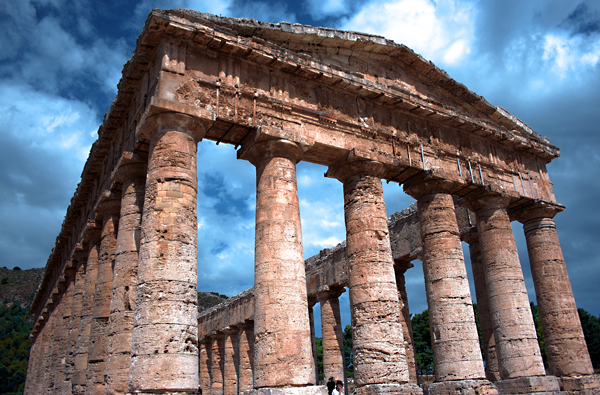
I couldn't help myself, I found another bracketed photo I took of the ruins at Segesta, in Sicily.
Enjoy!
Enjoy!
Comments are closed for this story
Newest HDR Image
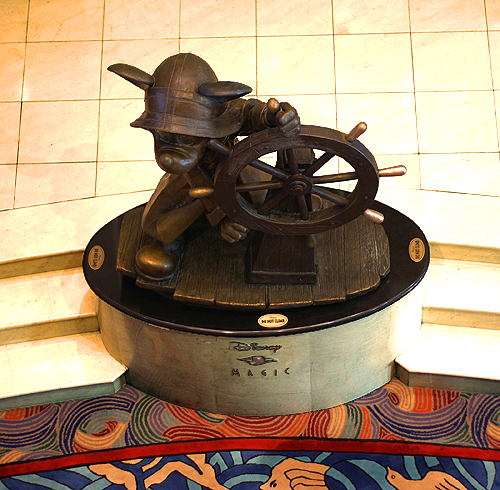
One of the things I'm really glad I did on my European Disney Cruise last summer was to take bracketed exposures of various shots.
That means I can come back and process some HDR (High Dynamic Range) photographs of those scenes.
The one for today is a shot of what I call "The Mouse at the Wheel" (Disney calls it "Helmsman Mickey"), a sculpture in the atrium of the Disney Magic inspired by "The Man at the Wheel", a cenotaph in Gloucester Mass.
I tried to avoid giving the photo the appearance of false color you sometimes get with HDR photos.
That means I can come back and process some HDR (High Dynamic Range) photographs of those scenes.
The one for today is a shot of what I call "The Mouse at the Wheel" (Disney calls it "Helmsman Mickey"), a sculpture in the atrium of the Disney Magic inspired by "The Man at the Wheel", a cenotaph in Gloucester Mass.
I tried to avoid giving the photo the appearance of false color you sometimes get with HDR photos.
Comments are closed for this story
Sun, 21 Sep 2008
Fox On Demand, Powered by Move Networks
Earlier this week, my Crapcast DVR decided that it didn't want to record the second episode of the Fox TV show "Fringe". I only realized this after Christine asked me if I'd deleted the episode.
After checking Fox's website, I realized that, in fact, the DVR failed to record the show. Before I could head to iTunes to download the episode, Fox's website seemed to have the show available for free.
After installing a plugin (Firefox calls it the MoveNetworks Quantum Media Player), within minutes I was downloading what appeared to be a near HD quality video stream of the full episode... without ads (well teasers/trailers seems like a small price to pay, but no ads inline, although when I just checked again, there do seem to be a few short ads interspersed)...
Warning: Geek content follows. For those not moderately interested in the mechanics behind this technology, suffice it to say, this is cool stuff, definitely check it out. The rest of this post will delve into the details of how it works.
I was skeptical of the video quality, but the approach that the MoveNetworks technology uses is ingenious. First, they split up the video into what they call "streamlets", or small "digestible" segments of video.
The advantages of this are multiple. First, if any network congestion or slowdowns are encountered by the client (which apparently has logic built in to determine if any frames are dropped), it can request the next streamlet of video at a slightly lower bitrate until the quality of the video matches the capacity of the network connection.
Secondly, this also means that there's very little buffering, and gives each viewer the best quality video that their connection can support at any given time.
Curious, I used tcpdump (for the nontech readers of this blog, this is a packet sniffer that allows the inspection of the data packets used for Internet communications) to identify what's happening underneath the covers.
The first question I wanted to know was whether they were using TCP or UDP. Typically streaming video uses UDP because it is generally a better protocol to use with applications which are time sensitive. In other words, if your connection gets really slow, there's no point in using a packet of data which contains video from 3 seconds ago. Video players that stutter back to 3 seconds ago once the data is obtained would be annoying. Much like Lucy should have done on the chocolate conveyor belt, let the ones go that are already on the floor, and focus on the ones coming down the line.
Interestingly, MoveNetworks uses TCP. With a "streamlet" strategy, they prefer to use the standard HTTP protocol (which uses TCP) which means they can use common web servers like Apache to keep their infrastructure costs low. (More on this in just a bit) Again, because their client has the intelligence to request smaller data packets when necessary, they intend to guarantee that the client only ask for data streams of "digestible size", to help guarantee that they drop very few frames of data.
Incidentally, this is a technique that TCP itself uses in negotiating window sizes. A window size, in the TCP protocol, is a negotiation technique that allows clients and servers to determine the ideal amount of data to be sent. Clients and servers that can handle larger and more packets gradually increase their carrying capacity until transmission failures occur, and then back off to about half that speed. The process continually repeats, providing, on what would on average appear to be 75% of the capacity of the network between the client and the server.
After what appears to be various tracking data being passed back to MoveNetworks, and some SSL traffic (secure traffic presumably intended to verify that the player requesting the data is an authorized player to help ensure that media pirates can't decode or fetch the streams), and a brief XML conversation, multiple HTTP streams are initiated at once to a content distribution network, or CDN. In this case, the CDN used is Limelight Networks, a competitor to the more widely known Akamai. (Note to the LimeLight security team-- you ought to suppress your server's response signature, as it's clear to anyone with a packet sniffer that you're using Apache/2.2.3.(CentOS))
All of this negotiation happens in a matter of 5 seconds or so. When the negotiation and authentication is complete, a standard HTTP request of "GET /qmplivefox/foxvod/ad/3ajn03/E575E001FD8 E254DB2E983A09D3B93F1_0400000003.qss HTTP/1.0" is requested from Limelight servers: "Host: move-od-405.vo.llnwd.net". The user agent is reported as "QSP.21:1[0].R{0-51698}". Interestingly enough, the portion of the user agent R{0-51698} is also requested as a standard HTTP content range header: "Range: bytes=0-51698".
As stated earlier, this is accompanied immediately by two other requests, this time with "Range: bytes=51699-10339" and "Range: bytes=103398-".
Generically, the responses tend to look like this (all standard HTTP stuff): "206 Partial Content", "Accept-Ranges: bytes", "Cache-Control: max-age=864000", "Content-Type: application/qss", "Age: 392446", "Date: Sun, 21 Sep 2008 04:33:06 GMT", "Last-Modified: Tue, 06 Nov 2007 03:41:11 GMT", "Expires: Fri, 26 Sep 2008 15:32:20 GMT", "Content-Range: bytes 0-51698/155097", "Content-Length: 51699", "Connection: close".
18ms later, the second response comes back with "Content-Range: bytes 51699-103397/155097", and 1ms after that, "Content-Range: bytes 103398-155096/155097".
Once these streams complete downloading, three new requests are made for 50KB of data each, this time for an incremented URI: "/qmplivefox/foxvod/ad/3ajn03/E575E001FD8E254DB2E983A09D3B93F1_0400000004.qss". It takes just 3 seconds to fetch another 150KB of data, so it would seem the initial packets establish a bitstream that is roughly 50KB/sec. (Compared to the H.264 codec, this bit rate would support a resolution of roughly 352x288@15.2 frames/sec)
Periodically, the https traffic continues to presumably update auth tokens to allow additional streams to be downloaded.
I didn't try to introduce network problems to see how the streams would be throttled back, but evidenced by decent video quality for nearly an hour, my broadband connection was able to sustain video quality that is of impressive quality.
Move has entered into agreements with other TV networks such as ABC and CW, which are also apparently using the Move technology. The client makes similar requests, "GET /vod/BBB87026/hss_113_finale_episode_1785344/A6B4B2BC1D05974993B831362BD5D9E4_0500000007.qss", although the traffic in this case goes to "stream.qec8.qcg1.qcn3.movenetworks.com" instead of to a CDN.
ABC shows a 1 minute ad you can't skip, unlike Fox, for each video "chapter". The ABC stream never got faster than "1623kbps" while watching Lost, and on the CW network, Supernatural never got past "730kbps" on my network. Traceroutes show that the ABC datacenter I'm using is in San Jose, and the CW network is also using the Limelight CDN.
These bitrates confirm my suspicion that the streams don't quite hit 720p HD quality, although they compare well to DVD quality.
After checking Fox's website, I realized that, in fact, the DVR failed to record the show. Before I could head to iTunes to download the episode, Fox's website seemed to have the show available for free.
After installing a plugin (Firefox calls it the MoveNetworks Quantum Media Player), within minutes I was downloading what appeared to be a near HD quality video stream of the full episode... without ads (well teasers/trailers seems like a small price to pay, but no ads inline, although when I just checked again, there do seem to be a few short ads interspersed)...
Warning: Geek content follows. For those not moderately interested in the mechanics behind this technology, suffice it to say, this is cool stuff, definitely check it out. The rest of this post will delve into the details of how it works.
I was skeptical of the video quality, but the approach that the MoveNetworks technology uses is ingenious. First, they split up the video into what they call "streamlets", or small "digestible" segments of video.
The advantages of this are multiple. First, if any network congestion or slowdowns are encountered by the client (which apparently has logic built in to determine if any frames are dropped), it can request the next streamlet of video at a slightly lower bitrate until the quality of the video matches the capacity of the network connection.
Secondly, this also means that there's very little buffering, and gives each viewer the best quality video that their connection can support at any given time.
Curious, I used tcpdump (for the nontech readers of this blog, this is a packet sniffer that allows the inspection of the data packets used for Internet communications) to identify what's happening underneath the covers.
The first question I wanted to know was whether they were using TCP or UDP. Typically streaming video uses UDP because it is generally a better protocol to use with applications which are time sensitive. In other words, if your connection gets really slow, there's no point in using a packet of data which contains video from 3 seconds ago. Video players that stutter back to 3 seconds ago once the data is obtained would be annoying. Much like Lucy should have done on the chocolate conveyor belt, let the ones go that are already on the floor, and focus on the ones coming down the line.
Interestingly, MoveNetworks uses TCP. With a "streamlet" strategy, they prefer to use the standard HTTP protocol (which uses TCP) which means they can use common web servers like Apache to keep their infrastructure costs low. (More on this in just a bit) Again, because their client has the intelligence to request smaller data packets when necessary, they intend to guarantee that the client only ask for data streams of "digestible size", to help guarantee that they drop very few frames of data.
Incidentally, this is a technique that TCP itself uses in negotiating window sizes. A window size, in the TCP protocol, is a negotiation technique that allows clients and servers to determine the ideal amount of data to be sent. Clients and servers that can handle larger and more packets gradually increase their carrying capacity until transmission failures occur, and then back off to about half that speed. The process continually repeats, providing, on what would on average appear to be 75% of the capacity of the network between the client and the server.
After what appears to be various tracking data being passed back to MoveNetworks, and some SSL traffic (secure traffic presumably intended to verify that the player requesting the data is an authorized player to help ensure that media pirates can't decode or fetch the streams), and a brief XML conversation, multiple HTTP streams are initiated at once to a content distribution network, or CDN. In this case, the CDN used is Limelight Networks, a competitor to the more widely known Akamai. (Note to the LimeLight security team-- you ought to suppress your server's response signature, as it's clear to anyone with a packet sniffer that you're using Apache/2.2.3.(CentOS))
All of this negotiation happens in a matter of 5 seconds or so. When the negotiation and authentication is complete, a standard HTTP request of "GET /qmplivefox/foxvod/ad/3ajn03/E575E001FD8 E254DB2E983A09D3B93F1_0400000003.qss HTTP/1.0" is requested from Limelight servers: "Host: move-od-405.vo.llnwd.net". The user agent is reported as "QSP.21:1[0].R{0-51698}". Interestingly enough, the portion of the user agent R{0-51698} is also requested as a standard HTTP content range header: "Range: bytes=0-51698".
As stated earlier, this is accompanied immediately by two other requests, this time with "Range: bytes=51699-10339" and "Range: bytes=103398-".
Generically, the responses tend to look like this (all standard HTTP stuff): "206 Partial Content", "Accept-Ranges: bytes", "Cache-Control: max-age=864000", "Content-Type: application/qss", "Age: 392446", "Date: Sun, 21 Sep 2008 04:33:06 GMT", "Last-Modified: Tue, 06 Nov 2007 03:41:11 GMT", "Expires: Fri, 26 Sep 2008 15:32:20 GMT", "Content-Range: bytes 0-51698/155097", "Content-Length: 51699", "Connection: close".
18ms later, the second response comes back with "Content-Range: bytes 51699-103397/155097", and 1ms after that, "Content-Range: bytes 103398-155096/155097".
Once these streams complete downloading, three new requests are made for 50KB of data each, this time for an incremented URI: "/qmplivefox/foxvod/ad/3ajn03/E575E001FD8E254DB2E983A09D3B93F1_0400000004.qss". It takes just 3 seconds to fetch another 150KB of data, so it would seem the initial packets establish a bitstream that is roughly 50KB/sec. (Compared to the H.264 codec, this bit rate would support a resolution of roughly 352x288@15.2 frames/sec)
Periodically, the https traffic continues to presumably update auth tokens to allow additional streams to be downloaded.
I didn't try to introduce network problems to see how the streams would be throttled back, but evidenced by decent video quality for nearly an hour, my broadband connection was able to sustain video quality that is of impressive quality.
Move has entered into agreements with other TV networks such as ABC and CW, which are also apparently using the Move technology. The client makes similar requests, "GET /vod/BBB87026/hss_113_finale_episode_1785344/A6B4B2BC1D05974993B831362BD5D9E4_0500000007.qss", although the traffic in this case goes to "stream.qec8.qcg1.qcn3.movenetworks.com" instead of to a CDN.
ABC shows a 1 minute ad you can't skip, unlike Fox, for each video "chapter". The ABC stream never got faster than "1623kbps" while watching Lost, and on the CW network, Supernatural never got past "730kbps" on my network. Traceroutes show that the ABC datacenter I'm using is in San Jose, and the CW network is also using the Limelight CDN.
These bitrates confirm my suspicion that the streams don't quite hit 720p HD quality, although they compare well to DVD quality.
Comments are closed for this story
Name/Blog: Nathaniel Porwitz
URL:
Title:
Comment/Excerpt: I've watched a lot of Move Networks content (my wife loves watching Bones on Fox's website, because the quality we get through their player is better than we get via DirecTV -- no HD DVR unfortunately). To your comment about the bitrates you saw from ABC and CW, it seems they allow their customers to decide what maximum bitrates to allow for their content. ABC.com even seems to use different max bitrates from show to show -- they list some of their shows as "HD" and some not. My guess is this is to make it easy for networks to define bandwidth usage limits. Nice info on their streaming, I hadn't done a tcpdump myself, interesting stuff.
URL:
Title:
Comment/Excerpt: I've watched a lot of Move Networks content (my wife loves watching Bones on Fox's website, because the quality we get through their player is better than we get via DirecTV -- no HD DVR unfortunately). To your comment about the bitrates you saw from ABC and CW, it seems they allow their customers to decide what maximum bitrates to allow for their content. ABC.com even seems to use different max bitrates from show to show -- they list some of their shows as "HD" and some not. My guess is this is to make it easy for networks to define bandwidth usage limits. Nice info on their streaming, I hadn't done a tcpdump myself, interesting stuff.
Ceding Our Leadership Position
We're letting the Indians win an important race.
No, I'm not talking about the "outsourcing" situation, which is simply an inevitable component of the current landscape when you have a population of well-educated engineers and call center workers in an economy where the prevailing wage is far more competitive than it is locally. As the Indian economy matures, the Indian services market (whether it's a C++ programmer or a call center operator) will begin to price itself out of the market, and those jobs will move to China, South America, and eventually Africa. Note to hopeful 3rd-world countries: follow India's lead and you too can witness the growth of a prosperous middle class...
Rather, I'm talking about some news this morning which indicates we're losing a race we should be in, that of space exploration. It appears somebody gets it in the Indian space administration, something that NASA has been unable to impress upon our current leadership. I'm talking about the harvesting of He3 from the moon.
In an article today, I was simultaneously excited (to hear the Indians are pursuing it) and chagrined (that it wasn't the US) to hear that India's mission to the moon has as a central focus, the prospect of mining He3.
No, I'm not talking about the "outsourcing" situation, which is simply an inevitable component of the current landscape when you have a population of well-educated engineers and call center workers in an economy where the prevailing wage is far more competitive than it is locally. As the Indian economy matures, the Indian services market (whether it's a C++ programmer or a call center operator) will begin to price itself out of the market, and those jobs will move to China, South America, and eventually Africa. Note to hopeful 3rd-world countries: follow India's lead and you too can witness the growth of a prosperous middle class...
Rather, I'm talking about some news this morning which indicates we're losing a race we should be in, that of space exploration. It appears somebody gets it in the Indian space administration, something that NASA has been unable to impress upon our current leadership. I'm talking about the harvesting of He3 from the moon.
In an article today, I was simultaneously excited (to hear the Indians are pursuing it) and chagrined (that it wasn't the US) to hear that India's mission to the moon has as a central focus, the prospect of mining He3.
Indian space scientists expect to map the lunar surface for the helium-3 (He-3) mineral to fuel nuclear power plants and frozen water as they make final preparations for India’s mission to the moon, expected to blast off next month.This is great news for humanity in general, because it means somebody is taking a leadership position for sustainable, non-polluting nuclear energy. It's bad news for the US, however, because it means that the Indians are beating us to the punch in harvesting He3 nuclear fuel.
Non-radioactive He-3 is scarce on earth but believed to be abundant on earth’s natural satellite and is seen as a promising fuel for advanced fusion reactors to generate power...
"The mission will help us locate He-3, which has the potential to produce a large amount of energy. It is expected that in a few years we can transport it from the moon to run nuclear plants and generate electricity," the director of the Indian Space Research Organisation’s (ISRO) satellite centre T K Alex said.
"Probably 10 years from now fusion reactors which can use He-3 will be available. Our second mission to the moon, Chandrayaan-II, will also have a lunar lander and help us collect samples of the mineral."
"In the next 40 years, it will be possible to transport it to the earth," he said.
Comments are closed for this story
Tue, 09 Sep 2008
Music Recommendation: Ravenous Soundtrack
My friend Rus blogged about an Icelandic band called Amiina, and one of their tracks, Hemipode (check out his blog for a listen) reminded me of one of my favorite soundtracks, the "Ravenous" soundtrack.
It's eerily atonal at times, and electronic at times, with bluegrass themes, and catchy choruses. You can listen to track samples at last.fm. True, some of the tracks sound like a Junior High band trying to warm up.
Others, however, such as Boyd's Journey, The Cave, Run, Manifest Destiny, and particularly the End Titles tracks fill a void in my musical repertoire like none other can. I love listening to Manifest Destiny in my car with the bass turned up really high. That's a track that needs to be felt to be experienced well.
One nice thing about modern technology is playlists. You can skip the uninspiring tracks (which probably fill a great purpose in the telling of the story of the movie-- this is a true soundtrack), and instead listen to music magic like Manifest Destiny.
My rating: (considering the playlist option to exclude uninteresting tracks) five stars.
Postscript: Manifest Destiny has, what I'd tonally call, what resembles a "dailing tone" or "busy signal" as one of its themes. Here are a few more songs that use that theme. Please submit any of your favorites that you think match.
It's eerily atonal at times, and electronic at times, with bluegrass themes, and catchy choruses. You can listen to track samples at last.fm. True, some of the tracks sound like a Junior High band trying to warm up.
Others, however, such as Boyd's Journey, The Cave, Run, Manifest Destiny, and particularly the End Titles tracks fill a void in my musical repertoire like none other can. I love listening to Manifest Destiny in my car with the bass turned up really high. That's a track that needs to be felt to be experienced well.
One nice thing about modern technology is playlists. You can skip the uninspiring tracks (which probably fill a great purpose in the telling of the story of the movie-- this is a true soundtrack), and instead listen to music magic like Manifest Destiny.
My rating: (considering the playlist option to exclude uninteresting tracks) five stars.
Postscript: Manifest Destiny has, what I'd tonally call, what resembles a "dailing tone" or "busy signal" as one of its themes. Here are a few more songs that use that theme. Please submit any of your favorites that you think match.
- In the Meantime, by Spacehog (YouTube video -- by the way, Spacehog rocks)
- Vienna Calling (YouTube video -- by the way, Falco rocks too)
- Kraftwerk (YouTube video -- do I have to say it?)
- Pink Floyd - Young Lust/Empty Spaces Interlude (YouTube video, 4:55 in)
- The Penguin Cafe Orchestra - Telephone and Rubber Band (YouTube video - in case you thought you'd heard the Spacehog music before)
Comments are closed for this story
Sun, 31 Aug 2008
New Project: ImageGetter
I put together a little project that attempts to gather the "zeitgeist" image from a particular web site, and returns it.
Here's how it might work... Imagine a message boards application, like PHPBB, for example. As you type in a URL to share, a little bit of javascript gets executed which loads an image from a remote page for you to include with the link.
Here's a Web 1.0 way of illustrating it (I need to get a nice AJAX library installed on my blog, so the 2.0 version is forthcoming). Just type in a URL into the box and click "Go". A new window will open with the "zeitgeist image", if there is an image that seems suitable. Works on sites like flickr, but not so much on google, although I suspect I could tweak it to work.
Here's how it might work... Imagine a message boards application, like PHPBB, for example. As you type in a URL to share, a little bit of javascript gets executed which loads an image from a remote page for you to include with the link.
Here's a Web 1.0 way of illustrating it (I need to get a nice AJAX library installed on my blog, so the 2.0 version is forthcoming). Just type in a URL into the box and click "Go". A new window will open with the "zeitgeist image", if there is an image that seems suitable. Works on sites like flickr, but not so much on google, although I suspect I could tweak it to work.
Comments are closed for this story
Sat, 16 Aug 2008
1.977 centimeters
Type the following query into google: "(100 m) / (50.58 s) * 0.01 seconds in centimeters" (or you can just click)...
The answer you get back will look like this:
What does this equation tell us?
Michael Phelps swam the 100m butterfly in 50.58 seconds, at an average rate of 1.97 meters per second (or roughly 6 feet every second).
He won this race by 1/100th of a second.
That means that he won this race by approximately 1.97706603 centimeters. For those of you not quite sure how far that is, (just ask Google "1.97706603 centimeters in inches") it's basically 3/4". This is remarkable for two reasons.
First, if they had touched closer to 3/8" apart, 1/200ths of a second would have elapsed between the touches, and the calibration of the timers would not have been able to tell the times apart-- that is, Cavic's time would likely have been the same as Phelps if they had touched any closer than 3/8ths of an inch because at the (average) speed they were swimming, such distance would represent a quantum of time less than 1/100th of a second.
Second, the irony is that the only reason he won by that much is that he thought he lost:
Amazing.
 | ((100 m) / (50.58 s)) * (0.01 seconds) = 1.97706603 centimeters |
What does this equation tell us?
Michael Phelps swam the 100m butterfly in 50.58 seconds, at an average rate of 1.97 meters per second (or roughly 6 feet every second).
He won this race by 1/100th of a second.
That means that he won this race by approximately 1.97706603 centimeters. For those of you not quite sure how far that is, (just ask Google "1.97706603 centimeters in inches") it's basically 3/4". This is remarkable for two reasons.
First, if they had touched closer to 3/8" apart, 1/200ths of a second would have elapsed between the touches, and the calibration of the timers would not have been able to tell the times apart-- that is, Cavic's time would likely have been the same as Phelps if they had touched any closer than 3/8ths of an inch because at the (average) speed they were swimming, such distance would represent a quantum of time less than 1/100th of a second.
Second, the irony is that the only reason he won by that much is that he thought he lost:
As soon as I took that last half stroke, to be honest, I thought I'd lost the race. I guess that was the difference because if I had glided then I would have came up short.If he didn't think he had lost, he wouldn't have taken another stroke, and wouldn't have beaten Cavic.
Amazing.
Comments are closed for this story
Fri, 15 Aug 2008
Olympic Swimming - A Bit Much?
Variety is the spice of life, as they say, but Olympic swimming is a little overboard.
I guess I'm an olympic "purist". While I appreciate many olympic sports, I don't think the olympics is the right venue for them.
<rant>
The original motto of the Olympics is "Citius, Altius, Fortius" ("Faster, Stronger, Higher"), so my unconventional opinion is that the olympics ought to consist purely of events that you can set world records in (by the way, these tend to be measures of faster, stronger higher...).
What does that leave in the olympics? Cycling, Rowing, Swimming, Track & Field, Triathlon, and Weightlifting. Everything else, in my wonderfully simplified world, would be cut.
</rant>
I did admit it was an unconventional opinion, no?
Further, I think each of these remaining sports ought to be distilled down to "faster, stronger, higher", which means they ought to eliminate the butterfly, backstroke and the breaststroke in swimming. They're simply concocted forms that cripple swimmers from swimming faster. (Track and Field could also benefit from killing events like the hurdles, speedwalking, and steeplechase, but at least you don't see stuff like the "100m crabwalk" and the "200m wheelbarrow" or the "400m bearwalk"... And weightlifting would lose the snatch, since all lifters can generally lift more using the clean and jerk-- but if you can do better with a snatch, more power to you.)
Anyway, olympic swimming would be a little less... obese... if it consisted of just 16 events-- 8 for women, 8 for men, six each of individual races of varying length from 50m to 1500m, and 2 each of relays. If you swim one of the other strokes faster than the freestyle, you're welcome to use it. The idea is to get from start to finish as fast as possible, in the water, and again, you ought to be able to do it any way you want, whether that's underwater, dolphin kicking all the way, or doing the doggy paddle.
Some of the events I would evict can either focus on existing annual or quadrannual events which attract the stars as much as or more than the olympics, and those that don't have such events could either create them, if there are enough viewers/fans to sustain it, or go on and sulk back into obscurity (rhythmic gymnastics, I'm talking about you).
Meanwhile, any of the existing sports wanting to change their format to faster/stronger/higher could come back. For example, in Gymnastics, the vault could become a distance event... "Nastia Lukin vaulted 34 feet!" or "Yang Wei held the iron cross for 17 seconds on the rings!" or "Kerry Walsh spiked a ball with the net at 2.25m" would work for me... Go ahead, call me crazy. :)
I guess I'm an olympic "purist". While I appreciate many olympic sports, I don't think the olympics is the right venue for them.
<rant>
The original motto of the Olympics is "Citius, Altius, Fortius" ("Faster, Stronger, Higher"), so my unconventional opinion is that the olympics ought to consist purely of events that you can set world records in (by the way, these tend to be measures of faster, stronger higher...).
What does that leave in the olympics? Cycling, Rowing, Swimming, Track & Field, Triathlon, and Weightlifting. Everything else, in my wonderfully simplified world, would be cut.
</rant>
I did admit it was an unconventional opinion, no?
Further, I think each of these remaining sports ought to be distilled down to "faster, stronger, higher", which means they ought to eliminate the butterfly, backstroke and the breaststroke in swimming. They're simply concocted forms that cripple swimmers from swimming faster. (Track and Field could also benefit from killing events like the hurdles, speedwalking, and steeplechase, but at least you don't see stuff like the "100m crabwalk" and the "200m wheelbarrow" or the "400m bearwalk"... And weightlifting would lose the snatch, since all lifters can generally lift more using the clean and jerk-- but if you can do better with a snatch, more power to you.)
Anyway, olympic swimming would be a little less... obese... if it consisted of just 16 events-- 8 for women, 8 for men, six each of individual races of varying length from 50m to 1500m, and 2 each of relays. If you swim one of the other strokes faster than the freestyle, you're welcome to use it. The idea is to get from start to finish as fast as possible, in the water, and again, you ought to be able to do it any way you want, whether that's underwater, dolphin kicking all the way, or doing the doggy paddle.
Some of the events I would evict can either focus on existing annual or quadrannual events which attract the stars as much as or more than the olympics, and those that don't have such events could either create them, if there are enough viewers/fans to sustain it, or go on and sulk back into obscurity (rhythmic gymnastics, I'm talking about you).
Meanwhile, any of the existing sports wanting to change their format to faster/stronger/higher could come back. For example, in Gymnastics, the vault could become a distance event... "Nastia Lukin vaulted 34 feet!" or "Yang Wei held the iron cross for 17 seconds on the rings!" or "Kerry Walsh spiked a ball with the net at 2.25m" would work for me... Go ahead, call me crazy. :)
Comments are closed for this story
Name/Blog: Jeff Lechtanski
URL: http://www.lechtanski.net
Title: Olympic Sympathizer
Comment/Excerpt: Following a strict constructionist model, confining the games to only timed events is too stringent. The ancient games included boxing and wrestling. And once you open the gates to competitions where your only goal is to take out the competitor, it is a slippery slope. You end up with beach volleyball.
Name/Blog: Khan
URL:
Title: Exactly...
Comment/Excerpt: That's why I didn't bother starting down the slope... I was tempted to keep boxing and wrestling for precisely the reason you stated, but it foiled my plan. Last thing we need is olympic golf, polo, arm wrestling, thumb wrestling (hey, why not?), and kickball.
URL: http://www.lechtanski.net
Title: Olympic Sympathizer
Comment/Excerpt: Following a strict constructionist model, confining the games to only timed events is too stringent. The ancient games included boxing and wrestling. And once you open the gates to competitions where your only goal is to take out the competitor, it is a slippery slope. You end up with beach volleyball.
Name/Blog: Khan
URL:
Title: Exactly...
Comment/Excerpt: That's why I didn't bother starting down the slope... I was tempted to keep boxing and wrestling for precisely the reason you stated, but it foiled my plan. Last thing we need is olympic golf, polo, arm wrestling, thumb wrestling (hey, why not?), and kickball.
Tue, 12 Aug 2008
New Blog Layout
I've widened the layout of my blog in anticipation of highlighting more of my photography. The previous layout favored more whitespace, but the wider format will play nicer not only for landscape photography, but allow for larger feature images.
Stay tuned for more!
Stay tuned for more!
Comments are closed for this story
Mon, 11 Aug 2008
Testing New Blog Feature
I'm testing a new feature I'm building that will automatically add EXIF data to images I load into my blog.
This is a test:

File name : blog_images/4th.jpg File size : 84395 bytes File date : 2009:04:30 15:35:18 Resolution : 470 x 706
This is a test:
File name : blog_images/4th.jpg File size : 84395 bytes File date : 2009:04:30 15:35:18 Resolution : 470 x 706
Comments are closed for this story
Photo of Lake Washington

Taken July 4th, 2008
Comments are closed for this story
Name/Blog: Christine
URL:
Title: Wow
Comment/Excerpt: You have become an amazing photographer!!
URL:
Title: Wow
Comment/Excerpt: You have become an amazing photographer!!
Exif Feature Added
I've added an exif feature, as you can see from the previous blog entry.
What this means for readers is that I can automagically include EXIF data (data that cameras encode into a jpg about how it was taken) for specific images by using a custom tag when I'm creating blog entries.
What this means for blosxom users who read my blog (just Rus, I presume) is that if you want to take advantage of this, I have a plugin for you, called add_exif.
If you don't use blosxom, and want a similar feature for your blog, and are reasonably comfortable with perl scripts, go ahead and take a look at the plugin... It wouldn't be hard to make an SSI out of it.
To see it in action, scroll down and observe what the image looks like below without a mouseover, and what happens when you mouse over it.
What this means for readers is that I can automagically include EXIF data (data that cameras encode into a jpg about how it was taken) for specific images by using a custom tag when I'm creating blog entries.
What this means for blosxom users who read my blog (just Rus, I presume) is that if you want to take advantage of this, I have a plugin for you, called add_exif.
If you don't use blosxom, and want a similar feature for your blog, and are reasonably comfortable with perl scripts, go ahead and take a look at the plugin... It wouldn't be hard to make an SSI out of it.
To see it in action, scroll down and observe what the image looks like below without a mouseover, and what happens when you mouse over it.
Comments are closed for this story
Name/Blog: rus
URL: http://rus.berrett.org/blog/
Title: oooo... very nice!
Comment/Excerpt: great work, nicely done!
URL: http://rus.berrett.org/blog/
Title: oooo... very nice!
Comment/Excerpt: great work, nicely done!
Fri, 08 Aug 2008
Mac vs. PC - $78 to $355 difference!
I've covered the topic of the Mac vs. PC price myth before, but a couple of recent developments led me to redo the comparison.
First, on a mailing list I'm on, one reader remarked, "[I] can't find a way to justify the ultra premium price which I find to be approximately 4x what I can build a Linux box for".
Second, Tom's Hardware recently published an article on "The Apple Mac Cost Misconception", where they compared a $2000 laptop from Dell and Apple, and a $2780 Mac Pro vs. a comparable home-built PC. The results, unsurprising to me, is that the Mac Pro is about a latte's difference ($5.87) away from the PC, which you have to take the time to put together yourself and doesn't come with an integrated warranty.
The problem with Tom's comparison, however, is that they didn't look at the low end of the scale. Now, all comparisons can be assailed in some fashion, including mine. What's important to state first and foremost is the thesis of the comparison. Namely, what could you get for your money if you were thinking about spending $599 for an entry-level Mac Mini from Apple? To make the comparison as fair as possible, I tried to replicate the market segment of the Mac Mini, by selecting the mini-ATX PC form factor (17cm x 17cm), and as similar as possible hardware.
I long ago (in 1998) abandoned the PC market, so I don't claim to have used the cheapest PC components. Surely, some of these can be found cheaper, but I think it's still illustrative to the point of "is a Mac really more expensive?" Rather, I followed in Tom's footsteps, for better or worse, as much as I could, to get pricing for the components. (I, like them, used Newegg.com's pricing and chose the cheapest, but most comparable component they sold. If anyone is interested, I'll post the URLs of all the products separately.)
Without any further ado, here's the price comparison: (boldface indicates line item winner)
In summary, the Mac mini is hands down a winner in just about every conceivable category. The attractive chassis is designed for the computer, and offers a convenient slot drive, and ports on the back for all of the features of the computer. For example, the handbuilt model has on-board firewire, but no external firewire port. Sure, you can buy a simple Firewire PCI card for less than $15, but the motherboard, chassis, and design spec of a mini-computer doesn't have room for it.
The one area the PC outpaces the Mac mini is in its 16X combo drive, compared to the mini's 8X drive. But this is more than made up for, in my mind, by the slot-loading drive which doesn't compete with other stuff on your desktop when the tray ejects.
Aside from this, the Mac mini runs up the score in every other category. Built-in bluetooth means no need to consume a USB slot with a clumsy dongle. The Mac mini has optical input and output via SPDIF mini jacks, which you'd have to buy a separate card for on the PC-- if you're willing to lose 802.11g. But even in that configuration, the price drops by $14 (lose 802.11g) and climbs by at least $25-30 or more dollars to get the optical SPDIF in/out ports via the PCI slot.
The gap widens a little more, or a lot more, depending on the software comparison. I compared the configuration to Ubuntu Linux, which isn't quite for everyone. However, the poster on the mailing list I'm on mentioned Linux, so I included the $1.75 media cost for Ubuntu. The price difference is dramatically different if you consider the comparison, as Tom's Hardware did it, with Windows Vista Ultimate, at another $277.49!
Finally, the Mac comes with all the hardware installed, a guarantee that the particular hardware configuration is going to work out of the box, no hardware or OS installation required, with no driver tweaks or OS support nightmares, a 1 year warranty, and the ability to take the box to an Apple store to have it serviced, if necessary.
Only those who already have (and discount the cost of) a spare wireless card, bluetooth dongle, DVD drive and spare 2.5" laptop drive could come close to the price of a Mac mini. More realistically, depending on the OS and specific options, the general public would be looking at a premium of anywhere between $78 to $355 more for a comparable PC than for a Mac mini.
First, on a mailing list I'm on, one reader remarked, "[I] can't find a way to justify the ultra premium price which I find to be approximately 4x what I can build a Linux box for".
Second, Tom's Hardware recently published an article on "The Apple Mac Cost Misconception", where they compared a $2000 laptop from Dell and Apple, and a $2780 Mac Pro vs. a comparable home-built PC. The results, unsurprising to me, is that the Mac Pro is about a latte's difference ($5.87) away from the PC, which you have to take the time to put together yourself and doesn't come with an integrated warranty.
The problem with Tom's comparison, however, is that they didn't look at the low end of the scale. Now, all comparisons can be assailed in some fashion, including mine. What's important to state first and foremost is the thesis of the comparison. Namely, what could you get for your money if you were thinking about spending $599 for an entry-level Mac Mini from Apple? To make the comparison as fair as possible, I tried to replicate the market segment of the Mac Mini, by selecting the mini-ATX PC form factor (17cm x 17cm), and as similar as possible hardware.
I long ago (in 1998) abandoned the PC market, so I don't claim to have used the cheapest PC components. Surely, some of these can be found cheaper, but I think it's still illustrative to the point of "is a Mac really more expensive?" Rather, I followed in Tom's footsteps, for better or worse, as much as I could, to get pricing for the components. (I, like them, used Newegg.com's pricing and chose the cheapest, but most comparable component they sold. If anyone is interested, I'll post the URLs of all the products separately.)
Without any further ado, here's the price comparison: (boldface indicates line item winner)
Apple Mac Mini $599.00 Homebuilt Mini-ITX PC
Chassis Included APEX Mini-ITX Case $ 55.99
Intel Core2Due 1.83Ghz CPU Included Intel Core2Duo 1.83Ghz CPU $278.75
Apple integrated motherboard Included JetWay Socket M Motherboard $189.99
1 External 400Mbps 1394b port Included 1 Internal only 1394b port Included
10/100/Gigabit Ethernet Included 10/100/Gigabit Ethernet Included
1GB 667MHz DDR2 SDRAM - 2x512MB Included Transcend 512MB RAM x2 $ 63.98
80GB Serial ATA drive Included TOSHIBA SATA 80GB drive $ 52.99
8X Slot-loading Combo drive Included ASUS 16x Combo Drive $ 13.99
Built-in Bluetooth 2.0 Included cirago USB 2.0 Bluetooth Dongle $ 6.50
Integrated consumes 1 USB Port
Built-in 802.11g Wireless Included Zonet 802.11g PCI Adapter $ 13.99
MacOS X Leopard Included Ubuntu Linux Media $ 1.75
---------------------------------------- ----------------------------------------
Total $599.00 $677.93
Extras:
Apple iLife 08 Not Available
w/iTunes, iPhoto, iMovie,
iDVD, iWeb, GarageBand
Optical SPDIF Input & Output Analog input/output only
Front Row Media Center Software Not Available
Apple Infrared Remote Not Available
In summary, the Mac mini is hands down a winner in just about every conceivable category. The attractive chassis is designed for the computer, and offers a convenient slot drive, and ports on the back for all of the features of the computer. For example, the handbuilt model has on-board firewire, but no external firewire port. Sure, you can buy a simple Firewire PCI card for less than $15, but the motherboard, chassis, and design spec of a mini-computer doesn't have room for it.
The one area the PC outpaces the Mac mini is in its 16X combo drive, compared to the mini's 8X drive. But this is more than made up for, in my mind, by the slot-loading drive which doesn't compete with other stuff on your desktop when the tray ejects.
Aside from this, the Mac mini runs up the score in every other category. Built-in bluetooth means no need to consume a USB slot with a clumsy dongle. The Mac mini has optical input and output via SPDIF mini jacks, which you'd have to buy a separate card for on the PC-- if you're willing to lose 802.11g. But even in that configuration, the price drops by $14 (lose 802.11g) and climbs by at least $25-30 or more dollars to get the optical SPDIF in/out ports via the PCI slot.
The gap widens a little more, or a lot more, depending on the software comparison. I compared the configuration to Ubuntu Linux, which isn't quite for everyone. However, the poster on the mailing list I'm on mentioned Linux, so I included the $1.75 media cost for Ubuntu. The price difference is dramatically different if you consider the comparison, as Tom's Hardware did it, with Windows Vista Ultimate, at another $277.49!
Finally, the Mac comes with all the hardware installed, a guarantee that the particular hardware configuration is going to work out of the box, no hardware or OS installation required, with no driver tweaks or OS support nightmares, a 1 year warranty, and the ability to take the box to an Apple store to have it serviced, if necessary.
Only those who already have (and discount the cost of) a spare wireless card, bluetooth dongle, DVD drive and spare 2.5" laptop drive could come close to the price of a Mac mini. More realistically, depending on the OS and specific options, the general public would be looking at a premium of anywhere between $78 to $355 more for a comparable PC than for a Mac mini.
Comments are closed for this story
Name/Blog: stiiky
URL:
Title: International...?
Comment/Excerpt: Hi khan.org, I have been reading many, many of these fighting comparisons between folks, on which is the better option and one is more expensive than the other etc etc. What i find interesting is the narrow scope to which all of these comparisons adhere. I live in Australia, and i will say that the Mac price gap is far more extended here. The same spec'd mac mini here costs $849. Now, to my mind, the comparison becomes blurred at that point. I recently put together a system, on paper, comparable to the top end imac (from a hardware point of view) for under $1000 (including 24" samsumg monitor). When you start comparing things at a performance level ,where the niche factor of board size plays less role, it is more difficult to compare. I know that there is the argument, as ever, that the OS is what you pay for. But if you are the type of person to assemble your system yourself, you are likely to be able to manipulate your OS to get he most out of it. And even for the mac experience there are Linux flavours which offer (admittedly impersonated) features like the mac: eg dashboard and the windows/file manager layout/spotlight. I am not saying either way, i have both, just saying that it changes for individuals as well as for locations. Many wishes for your future Blogging. Stiiky
Name/Blog: Khan
URL:
Title: Response to stiiky
Comment/Excerpt: You make a good point, the price comparisons can vary from country to country, and product by product. I will say, however, that comparing to the "top end imac" which is an all in one form factor, may not be a fair comparison for some people... For those who care less if their CPU and display are separate units, your comparison will demonstrate the value of a PC. On the other hand, finding an enclosure that you can build a PC to the back of an LCD, well, that's custom work that will not be cost competitive to "build yourself"...
Name/Blog: Stiiky
URL:
Title: The points are never not valid
Comment/Excerpt: This will go back and forward forever. Of course, form factor will be a factor in it all, and the eye candy associated with things is the only feature to distinguish between anyone's "guns". If that was to be taken out of account, you could always set up a good, strong PC, hook it up to a decent projector and, for about the cost of the iMac, you have an ENORMOUS screen, form factor is not an issue and everything is hunky doory :p I don't often comment on these things, because there are so very many threads which do contest this exact point of view. I only chose to here, because i thought you presented a very well balanced and level headed argument. I want to say that, having read some of the other posts on here, i like the cut of your jib andi will concede that personal flavour and taste are the biggest factors between people. i look forward to reading many more posts in the future. regards, Stiiky PS a Vesa mounton the back of your lcd coul solve the form factor :p
Name/Blog: Khan
URL:
Title:
Comment/Excerpt: I think you made my point there, though. :) That is, if a PC costs the same as an iMac, you can hook the iMac up to the projector and voila... Enormous screen, and form factor is not an issue. In that case, then it simply comes down to user preference... If you ever want to run OS X (legally) you have to choose the Mac. If you want to run Windows or Linux, pick either the Mac or the PC, both will run either OS well enough.
Name/Blog: stiiky
URL:
Title:
Comment/Excerpt: just to clarify...i meant you could get the pc AND the projector(where i am at least) for the cost of the iMac. Bit of a difference there.
URL:
Title: International...?
Comment/Excerpt: Hi khan.org, I have been reading many, many of these fighting comparisons between folks, on which is the better option and one is more expensive than the other etc etc. What i find interesting is the narrow scope to which all of these comparisons adhere. I live in Australia, and i will say that the Mac price gap is far more extended here. The same spec'd mac mini here costs $849. Now, to my mind, the comparison becomes blurred at that point. I recently put together a system, on paper, comparable to the top end imac (from a hardware point of view) for under $1000 (including 24" samsumg monitor). When you start comparing things at a performance level ,where the niche factor of board size plays less role, it is more difficult to compare. I know that there is the argument, as ever, that the OS is what you pay for. But if you are the type of person to assemble your system yourself, you are likely to be able to manipulate your OS to get he most out of it. And even for the mac experience there are Linux flavours which offer (admittedly impersonated) features like the mac: eg dashboard and the windows/file manager layout/spotlight. I am not saying either way, i have both, just saying that it changes for individuals as well as for locations. Many wishes for your future Blogging. Stiiky
Name/Blog: Khan
URL:
Title: Response to stiiky
Comment/Excerpt: You make a good point, the price comparisons can vary from country to country, and product by product. I will say, however, that comparing to the "top end imac" which is an all in one form factor, may not be a fair comparison for some people... For those who care less if their CPU and display are separate units, your comparison will demonstrate the value of a PC. On the other hand, finding an enclosure that you can build a PC to the back of an LCD, well, that's custom work that will not be cost competitive to "build yourself"...
Name/Blog: Stiiky
URL:
Title: The points are never not valid
Comment/Excerpt: This will go back and forward forever. Of course, form factor will be a factor in it all, and the eye candy associated with things is the only feature to distinguish between anyone's "guns". If that was to be taken out of account, you could always set up a good, strong PC, hook it up to a decent projector and, for about the cost of the iMac, you have an ENORMOUS screen, form factor is not an issue and everything is hunky doory :p I don't often comment on these things, because there are so very many threads which do contest this exact point of view. I only chose to here, because i thought you presented a very well balanced and level headed argument. I want to say that, having read some of the other posts on here, i like the cut of your jib andi will concede that personal flavour and taste are the biggest factors between people. i look forward to reading many more posts in the future. regards, Stiiky PS a Vesa mounton the back of your lcd coul solve the form factor :p
Name/Blog: Khan
URL:
Title:
Comment/Excerpt: I think you made my point there, though. :) That is, if a PC costs the same as an iMac, you can hook the iMac up to the projector and voila... Enormous screen, and form factor is not an issue. In that case, then it simply comes down to user preference... If you ever want to run OS X (legally) you have to choose the Mac. If you want to run Windows or Linux, pick either the Mac or the PC, both will run either OS well enough.
Name/Blog: stiiky
URL:
Title:
Comment/Excerpt: just to clarify...i meant you could get the pc AND the projector(where i am at least) for the cost of the iMac. Bit of a difference there.
Thu, 07 Aug 2008
Blue Angels at Seafair 2008
On Sunday I took a couple hours to get out of the house and snap some pics of the Blue Angels from Mercer Island.

You can check out all of the pics by clicking on the image, which links to my photoset at Flickr.
Most pictures were taken with my 70-300mm 4-5.6IS/USM lens... However this outing really helped me see the shortcomings of the lens (warning: the remainder of this post consists of photo-geekery, safe to stop reading if this kind of stuff bores you :)...
Don't get me wrong, it is a quite excellent lens, particularly for the money. But here's where this lens, in my opinion, falls a bit short.
I like the 70-300mm range that this lens provides as a "walk around" lens. Certainly the 70-300mm is no slouch for landscape or still photography, but for action shots, its no surprise that people opt for the faster L series lenses. I'm not frustrated enough that I'd consider replacing this lens with an L series lens (for one, most affordable lenses stop at 200mm, and I find the extra 100mm of zoom extremly useful)... but I might rent a lens for action photography in the future.
You can check out all of the pics by clicking on the image, which links to my photoset at Flickr.
Most pictures were taken with my 70-300mm 4-5.6IS/USM lens... However this outing really helped me see the shortcomings of the lens (warning: the remainder of this post consists of photo-geekery, safe to stop reading if this kind of stuff bores you :)...
Don't get me wrong, it is a quite excellent lens, particularly for the money. But here's where this lens, in my opinion, falls a bit short.
- The lens has a maximum aperture of f4 at 70mm, and 5.6 at 300mm. This means keeping the lens in manual mode requires you adjust the ISO or exposure constantly if you have to dynamically zoom in/out. As a result all of the pics were taken in auto mode, which means that on my XTI, no RAW images (for maximum flexibility in digital post-processing).
- The USM focus is really slow. If the autofocus happens to miss the object you're trying to focus on (like a fast flying jet), by the time it focuses close and goes back out far, the objective you're trying to shoot might be out of visual range.
- When you spend over $500 on a lens from Canon, they really should throw in the lens hood. Or, put another way, if you're buying a lens, and it doesn't come with a hood, you're either getting somewhat false economy (considering Canon's high end lenses come with them, price comparisons of cheaper lenses against an L series should include a hood to compare apples to apples)
- I didn't use a polarizing filter (I've yet to make a significant invest in any filters for my lenses) but I can see how it'd be frustrating to use one with this lens-- the front lens rotates as you zoom in/out, so adjusting the filter would be a pain during action photography.
I like the 70-300mm range that this lens provides as a "walk around" lens. Certainly the 70-300mm is no slouch for landscape or still photography, but for action shots, its no surprise that people opt for the faster L series lenses. I'm not frustrated enough that I'd consider replacing this lens with an L series lens (for one, most affordable lenses stop at 200mm, and I find the extra 100mm of zoom extremly useful)... but I might rent a lens for action photography in the future.
Comments are closed for this story
Mon, 04 Aug 2008
Happy 4th of July
I'm getting a lot better at fireworks photography. Here's one of the best of a few dozen pics I took.
Happy 4th of July!
Happy 4th of July!
Comments are closed for this story
Name/Blog: Christine
URL:
Title:
Comment/Excerpt: Amazing photo!! Nice job.
Name/Blog: Tim
URL:
Title: very nice!
Comment/Excerpt: that's a great shot!
Name/Blog: Justin
URL:
Title: nice fireworks
Comment/Excerpt: If you wouldn't mind, I'd love a little blurb about your camera settings, lenses, tripods used to make that shot.
URL:
Title:
Comment/Excerpt: Amazing photo!! Nice job.
Name/Blog: Tim
URL:
Title: very nice!
Comment/Excerpt: that's a great shot!
Name/Blog: Justin
URL:
Title: nice fireworks
Comment/Excerpt: If you wouldn't mind, I'd love a little blurb about your camera settings, lenses, tripods used to make that shot.
Sun, 03 Aug 2008
What's your TravelIQ?
I was on tripadvisor, and found a neat flash app that test your world geography skills.
Post your scores in the comments!
Post your scores in the comments!
Comments are closed for this story
Wed, 09 Jul 2008
Fireworks Photography
Justin asked what settings I used for the pic below.
Camera: Canon Digital Rebel, XTI @ 100 ISO in Manual mode. "Bulb" exposure. Manual shutter release, five second exposure.
Lens: 24-70mm 2.8L at 67mm focal length, stopped down to f10.
Tripod: Hakuba HG-503MX with factory head.
I chose f10 and ISO 100 because fireworks are actually quite bright, and I wanted exposures several seconds long to get enough "action" in the shot.
More of the (as always, full resolution!) pics are at this 4th of July Flickr set.
Camera: Canon Digital Rebel, XTI @ 100 ISO in Manual mode. "Bulb" exposure. Manual shutter release, five second exposure.
Lens: 24-70mm 2.8L at 67mm focal length, stopped down to f10.
Tripod: Hakuba HG-503MX with factory head.
I chose f10 and ISO 100 because fireworks are actually quite bright, and I wanted exposures several seconds long to get enough "action" in the shot.
More of the (as always, full resolution!) pics are at this 4th of July Flickr set.
Comments are closed for this story
Tue, 24 Jun 2008
Wall•e Review
Last night Christine and I caught a sneak preview of Wall•e at Pacific Place.
In summary, this is simply the best movie of the year, and the best Pixar movie ever made.
The story telling, the characters, the themes, the movie excels at all of these, and more. The visual quality of the movie is astounding. I had to keep reminding Christine that this wasn't a real scene, particularly during the beginning of the movie where the bulk of the animation is spent on characters named Wall•e, Eve, and a cockroach.
I don't know how they do it, but they make the lead characters endearing without any significant dialogue-- and they're robots!
I give it five stars... I suspect this will break ground in ways that no animated movie ever has.
In summary, this is simply the best movie of the year, and the best Pixar movie ever made.
The story telling, the characters, the themes, the movie excels at all of these, and more. The visual quality of the movie is astounding. I had to keep reminding Christine that this wasn't a real scene, particularly during the beginning of the movie where the bulk of the animation is spent on characters named Wall•e, Eve, and a cockroach.
I don't know how they do it, but they make the lead characters endearing without any significant dialogue-- and they're robots!
I give it five stars... I suspect this will break ground in ways that no animated movie ever has.
Comments are closed for this story
Name/Blog: Maelyn
URL: mostlycoastal.com
Title:
Comment/Excerpt: We saw this today. Included in the posse were 2 three year olds,a six year old, a thirty year old and a thirty-three year old... and am not sure who enjoyed it more. Thanks for the recommendation! This is the first movie I have been to since Jan 2005.
URL: mostlycoastal.com
Title:
Comment/Excerpt: We saw this today. Included in the posse were 2 three year olds,a six year old, a thirty year old and a thirty-three year old... and am not sure who enjoyed it more. Thanks for the recommendation! This is the first movie I have been to since Jan 2005.
Mon, 09 Jun 2008
Everything Old Is New Again (Server Push & no-parse headers)
In 1995, the rage on the Internet was Netscape. They had just released Netscape 1.1, and it shipped with a new feature called "server-push". The guys at Netscape applied a concept from email (MIME type: multipart/mixed from mail attachments) and created multipart/mixed-replace. The idea was that sometimes you don't want people to download your web page, and have it remain on the screen-- sometimes you want the content to be refreshed, when and if the server chooses, and replace what was pushed a moment before.
I recall opening up Photoshop, creating several layers, and exporting GIFs that would get refreshed, and writing some CGI programs that would use this new mime type to display, what were in effect, server-driven animated GIFs. On the server side, you had to convince httpd (now apache) not to server-parse the response to the client... Since you, the programmer, had to decide what content to push to the client, having the server compute the mime type (is it a JPEG? A GIF? A HTML document?) or the content length (is this GIF larger or smaller than the one before it?) by parsing the content wouldn't work. So, a convention was born to precede any such scripts with "nph-", meaning, "let me tell the client what kind of file and how big it is..."
I just finished a project that incorporates this technology, but didn't realize that I'd be brushing up on this technique I first learned 13 years ago.
With a baby on the way, I wanted a baby-monitor I could check even when I was back at work. Most off-the-shelf baby monitors use limited range 900Mhz wireless spectrum with no Internet capabilities. Instead, I got a couple of Panasonic pan/tilt/zoom webcams, and to save $80/unit, I also got some Panasonic powerline adapters so I didn't have to buy the more expensive 802.11g versions. The adapters allow me to avoid inconvenient wiring, and keep the video IP traffic off my wireless network.
The cameras have a live video feature, which I didn't really think much about how it worked... It worked just fine in Safari and Firefox, and that's all that mattered. But live video is limited-- you can't see what activity has taken place throughout the day. Well it turns out the cameras have security features, allowing me to upload JPG still captures from the cameras when their motion detectors are tripped.
But the problem was, each time the sensor is tripped several dozen images would get uploaded to a remote directory, and I'd have to manually go through them one at a time.
It was neat, however, to be out and about, and to be able to pull up my iPhone and see who's been at my front door, or if my cats have been jumping into the crib...
The first incarnation of this project was simply an apache directory-index. Click the file, see the still, click back, click another file... Repeat ad nauseam.
So I thought, hmm, perhaps I can build a file manager and use some software to seam the images into an mpeg movie, or motion-jpeg. Group the images by hour of day, and provide a "delete" function so that I don't have thousands of images piling up...
Then the thought hit me to use server-push (by now you probably saw this coming), and as I did a little tcpdump (network packet sniffing) analysis, I realized that this is the exact same thing that the camera's firmware is doing for any browsers monitoring the "video" feed...
After a little web coding (1455 bytes to be exact-- I'll post it if anyone is interested), I wrote a simple script that lets me browse all the events that my camera has captured and uploaded to the Internet, view them in equivalent video quality as the camera's built-in server, and when I'm done, delete the batch of files representing that video.
But best of all, MobileSafari.app (the browser on the iPhone) can handle multipart/mixed-replace content!
I recall opening up Photoshop, creating several layers, and exporting GIFs that would get refreshed, and writing some CGI programs that would use this new mime type to display, what were in effect, server-driven animated GIFs. On the server side, you had to convince httpd (now apache) not to server-parse the response to the client... Since you, the programmer, had to decide what content to push to the client, having the server compute the mime type (is it a JPEG? A GIF? A HTML document?) or the content length (is this GIF larger or smaller than the one before it?) by parsing the content wouldn't work. So, a convention was born to precede any such scripts with "nph-", meaning, "let me tell the client what kind of file and how big it is..."
I just finished a project that incorporates this technology, but didn't realize that I'd be brushing up on this technique I first learned 13 years ago.
With a baby on the way, I wanted a baby-monitor I could check even when I was back at work. Most off-the-shelf baby monitors use limited range 900Mhz wireless spectrum with no Internet capabilities. Instead, I got a couple of Panasonic pan/tilt/zoom webcams, and to save $80/unit, I also got some Panasonic powerline adapters so I didn't have to buy the more expensive 802.11g versions. The adapters allow me to avoid inconvenient wiring, and keep the video IP traffic off my wireless network.
The cameras have a live video feature, which I didn't really think much about how it worked... It worked just fine in Safari and Firefox, and that's all that mattered. But live video is limited-- you can't see what activity has taken place throughout the day. Well it turns out the cameras have security features, allowing me to upload JPG still captures from the cameras when their motion detectors are tripped.
But the problem was, each time the sensor is tripped several dozen images would get uploaded to a remote directory, and I'd have to manually go through them one at a time.
It was neat, however, to be out and about, and to be able to pull up my iPhone and see who's been at my front door, or if my cats have been jumping into the crib...
The first incarnation of this project was simply an apache directory-index. Click the file, see the still, click back, click another file... Repeat ad nauseam.
So I thought, hmm, perhaps I can build a file manager and use some software to seam the images into an mpeg movie, or motion-jpeg. Group the images by hour of day, and provide a "delete" function so that I don't have thousands of images piling up...
Then the thought hit me to use server-push (by now you probably saw this coming), and as I did a little tcpdump (network packet sniffing) analysis, I realized that this is the exact same thing that the camera's firmware is doing for any browsers monitoring the "video" feed...
After a little web coding (1455 bytes to be exact-- I'll post it if anyone is interested), I wrote a simple script that lets me browse all the events that my camera has captured and uploaded to the Internet, view them in equivalent video quality as the camera's built-in server, and when I'm done, delete the batch of files representing that video.
But best of all, MobileSafari.app (the browser on the iPhone) can handle multipart/mixed-replace content!
Comments are closed for this story
Sun, 01 Jun 2008
On Apple Rumors...
The rumor sites are agog about the forthcoming 3G iPhone. Some rumors suggest that the iPhone will come with built-in GPS, others suggesting larger capacity in a smaller form-factor.
Even if the new iPhone remains at 8GB and remains the same size, "3G is enough" because the biggest bottleneck of the current iPhone is the speed of the EDGE network. With broadband comes the ability to network the iPhone with computers in your home and work networks.
I think this is likely to be a cross-platform integration, meaning that so long as your computer is running Safari or iTunes (which means either Windows or OS X), broadband 3G access means ubiquitous access to your bookmarks and your music library anywhere you can get a 3G cell signal. This also opens up the potential to be able to browse the iTunes music store from your cell phone, even outside the range of WiFi.
But another bottleneck exists on the current iPhone, which could actually just be lifted with a firmware upgrade, no 3G iPhone necessary. I'm talking about the requirement of a USB cable to sync your phone when the wireless bandwidth is there today (at least with WiFi). How cool would it be to sync your phone not only without a cable, but from anywhere in the world?
But I think limiting the iPhone to syncing with a single device is rather limiting... A key strategy for nearly every business is to sell your customers a product, and then find a way to sell that same customer another product. This strategy is simply what is responsible for Apple's recent meteoric rise on Wall Street-- they went from selling computers to less than 5% of the overall market, to selling iPods to nearly every man woman and child, to selling music tracks to selling phones, and set-top boxes...
...Set top boxes... which is where I think there is a lot of potential for Apple to expand their growth. It's not a far cry to consider than the iPhone could very well be a sophisticated remote control for your Front Row software on your Mac, or for your AppleTV, for that matter. But the AppleTV hasn't seen the kind of success that the iPod, iPhone, or even the Mac has in recent years.
In a previous post I suggested that ubiquitous uber-broadband access that would allow streaming HD content is still quite a ways off, at least over the Internet. And so I think an opportunity exists for Apple to shift their strategy around the AppleTV in order to capture more of the set-top-box market.
But as my friend Gavin pointed out, people just don't want another box in their entertainment console. The AppleTV would have to displace something to make significant inroads, and I see two simple feature additions that Apple could provide to get there.
The first of which, and the least likely of the two by my estimation, is one or more CableCard slots and/or a coax slot. The AppleTV, with its built-in hard drive, could put many a DVR to shame. Clearly TiVo has some of the best software on the market, but providers like Comcast still have a shocking number of their DVRs in American homes, sadly, including mine. This could even be sold in such a way as "miss something on your DVR? Download it from iTunes.com with your AppleTV"...
The second way to break into the consumer set-top-box market would be to simply drop in a BluRay drive. Clearly, Sony has the lead in this area today with their PS3s leading the BluRay revolution, and the reason they can afford to do so is because of the upside to Sony if BluRay gets a good portion of the market from licensing, movies, games, and media. They also have a financial model to make up the hardware losses with software and licensing margins, but so, presumably, would Apple.
In particular, getting revenue from iTunes music store purchases, video downloads, and monthly DVR service, the extra cost of putting in a BluRay drive might not be that much of a stretch of the imagination.
How likely is this scenario? There's a lot of speculation in this post, and I think it's very unlikely that it'll all come true, but I leave you with this final thought:
If I'm right, and Apple is still executing its strategy to move from "Apple Computer Inc." to the ubiquitous stylish consumer technology company "Apple", then the branding of the glue that ties all of these consumer devices together as ".Mac" begins to seem quite "off-message"... What you'd need, if indeed the iPhone becomes the central "remote control" of your digital lifestyle, if it becomes the device that defines the way you come to interact with data and services on both your computer, and your media center, is a service that is branded around the fact that it gives you access to "all of your stuff" no matter where you are*.
Which is my long-winded way of explaining what I think is the reasoning behind the purported rumor that Apple is renaming "dotMac" to ".me.com"...
(* So long as you're in range of a 3G data network)
Even if the new iPhone remains at 8GB and remains the same size, "3G is enough" because the biggest bottleneck of the current iPhone is the speed of the EDGE network. With broadband comes the ability to network the iPhone with computers in your home and work networks.
I think this is likely to be a cross-platform integration, meaning that so long as your computer is running Safari or iTunes (which means either Windows or OS X), broadband 3G access means ubiquitous access to your bookmarks and your music library anywhere you can get a 3G cell signal. This also opens up the potential to be able to browse the iTunes music store from your cell phone, even outside the range of WiFi.
But another bottleneck exists on the current iPhone, which could actually just be lifted with a firmware upgrade, no 3G iPhone necessary. I'm talking about the requirement of a USB cable to sync your phone when the wireless bandwidth is there today (at least with WiFi). How cool would it be to sync your phone not only without a cable, but from anywhere in the world?
But I think limiting the iPhone to syncing with a single device is rather limiting... A key strategy for nearly every business is to sell your customers a product, and then find a way to sell that same customer another product. This strategy is simply what is responsible for Apple's recent meteoric rise on Wall Street-- they went from selling computers to less than 5% of the overall market, to selling iPods to nearly every man woman and child, to selling music tracks to selling phones, and set-top boxes...
...Set top boxes... which is where I think there is a lot of potential for Apple to expand their growth. It's not a far cry to consider than the iPhone could very well be a sophisticated remote control for your Front Row software on your Mac, or for your AppleTV, for that matter. But the AppleTV hasn't seen the kind of success that the iPod, iPhone, or even the Mac has in recent years.
In a previous post I suggested that ubiquitous uber-broadband access that would allow streaming HD content is still quite a ways off, at least over the Internet. And so I think an opportunity exists for Apple to shift their strategy around the AppleTV in order to capture more of the set-top-box market.
But as my friend Gavin pointed out, people just don't want another box in their entertainment console. The AppleTV would have to displace something to make significant inroads, and I see two simple feature additions that Apple could provide to get there.
The first of which, and the least likely of the two by my estimation, is one or more CableCard slots and/or a coax slot. The AppleTV, with its built-in hard drive, could put many a DVR to shame. Clearly TiVo has some of the best software on the market, but providers like Comcast still have a shocking number of their DVRs in American homes, sadly, including mine. This could even be sold in such a way as "miss something on your DVR? Download it from iTunes.com with your AppleTV"...
The second way to break into the consumer set-top-box market would be to simply drop in a BluRay drive. Clearly, Sony has the lead in this area today with their PS3s leading the BluRay revolution, and the reason they can afford to do so is because of the upside to Sony if BluRay gets a good portion of the market from licensing, movies, games, and media. They also have a financial model to make up the hardware losses with software and licensing margins, but so, presumably, would Apple.
In particular, getting revenue from iTunes music store purchases, video downloads, and monthly DVR service, the extra cost of putting in a BluRay drive might not be that much of a stretch of the imagination.
How likely is this scenario? There's a lot of speculation in this post, and I think it's very unlikely that it'll all come true, but I leave you with this final thought:
If I'm right, and Apple is still executing its strategy to move from "Apple Computer Inc." to the ubiquitous stylish consumer technology company "Apple", then the branding of the glue that ties all of these consumer devices together as ".Mac" begins to seem quite "off-message"... What you'd need, if indeed the iPhone becomes the central "remote control" of your digital lifestyle, if it becomes the device that defines the way you come to interact with data and services on both your computer, and your media center, is a service that is branded around the fact that it gives you access to "all of your stuff" no matter where you are*.
Which is my long-winded way of explaining what I think is the reasoning behind the purported rumor that Apple is renaming "dotMac" to ".me.com"...
(* So long as you're in range of a 3G data network)
Comments are closed for this story
Tech Projects Update
I've been on a tech-projects update kick recently. Not only did I upgrade the disk in my laptop a couple days ago, I also ordered the parts I needed for two other tech projects.
First, my good friend Gavin was moving and he didn't have the time nor inclination to fix his Apple 20" display, so he generously offered it to me with the warning that it was potentially on its last legs.
Also, I have an "800Mhz G4 iMac (Flat Screen)" (that's precisely what Apple calls it) that I've been wanting to install OS X 10.5 "Leopard" onto. In particular, I want to dovetail that computer onto the network backup scheme I've got going between my laptop and my Drobo. This computer is essentially my home "server", which runs Apache, MySQL, and a few other open source tools and utilities. Problem is, Leopard only installs on computers that have 512MB of RAM and a 867Mhz G4 processor or better.
Apparently the failure rate of the 20" displays are high enough that there's a cottage industry of replacement parts you can buy from companies like lcdparts.net. And as far as the 800Mhz G4, there's a neat utility called Leopard Assist which overwrites your CPU settings stored in Open Firmware with 867Mhz to fool the Leopard Installer into thinking your computer is faster than it really is.
Sure enough Leopard Assist allowed Leopard to begin installing, except I was reminded that my G4 iMac only has 384MB of memory-- 64MB in the user-installable slot, and 256MB in the "factory installed" slot. Drat. So, I ordered 512MB of RAM from Buy.com for the user-installable slot.
Well I installed the lcdparts.net inverter board, and the 20" display went from half-dim and partially usable, to not usable at all, which was a painful discovery after putting in all 27 some screws back in and reassembling the whole thing.
Taking it all back apart and putting the old, broken board (incidentally you can see the capacitor that gave up the ghost which spewed all its guts on the circuit board) back in confirmed that in fact, lcdparts shipped me a defective inverter board. *sigh*
But my tech projects sense of accomplishment was not all for naught... I still had the RAM upgrade to perform... My 144-pin SO-DIMM (which stands for "Small Outline Double In-line Memory Module") had arrived from Buy.com, so I could still achieve one of my goals!
So I open up the Buy.com box, and what's inside?
A packing slip that shows two parts-- the one part I ordered, and another part, a 168-pin DIMM. And what's in the box is... yep-- a 168-pin full size DIMM. ("Small Outline" RAM chips are used in laptops and constrained volume computers like the iMac and Mac mini)
Argh!
So back to the drawing board... Until I realized that the factory installed memory module takes the kind of RAM Buy.com wrongly sent me. So I pulled out my torx screwdriver set, took apart the iMac, pulled out the 256MB memory in the factory slot, and installed the mistakenly shipped product. I had hoped to have a 768MB Leopard box, but 576MB will do the trick too.
At least Other World Computing sent me the right hard drive and upgrade kit, as that's the only tech project that went off without a hitch this week.
First, my good friend Gavin was moving and he didn't have the time nor inclination to fix his Apple 20" display, so he generously offered it to me with the warning that it was potentially on its last legs.
Also, I have an "800Mhz G4 iMac (Flat Screen)" (that's precisely what Apple calls it) that I've been wanting to install OS X 10.5 "Leopard" onto. In particular, I want to dovetail that computer onto the network backup scheme I've got going between my laptop and my Drobo. This computer is essentially my home "server", which runs Apache, MySQL, and a few other open source tools and utilities. Problem is, Leopard only installs on computers that have 512MB of RAM and a 867Mhz G4 processor or better.
Apparently the failure rate of the 20" displays are high enough that there's a cottage industry of replacement parts you can buy from companies like lcdparts.net. And as far as the 800Mhz G4, there's a neat utility called Leopard Assist which overwrites your CPU settings stored in Open Firmware with 867Mhz to fool the Leopard Installer into thinking your computer is faster than it really is.
Sure enough Leopard Assist allowed Leopard to begin installing, except I was reminded that my G4 iMac only has 384MB of memory-- 64MB in the user-installable slot, and 256MB in the "factory installed" slot. Drat. So, I ordered 512MB of RAM from Buy.com for the user-installable slot.
Well I installed the lcdparts.net inverter board, and the 20" display went from half-dim and partially usable, to not usable at all, which was a painful discovery after putting in all 27 some screws back in and reassembling the whole thing.
Taking it all back apart and putting the old, broken board (incidentally you can see the capacitor that gave up the ghost which spewed all its guts on the circuit board) back in confirmed that in fact, lcdparts shipped me a defective inverter board. *sigh*
But my tech projects sense of accomplishment was not all for naught... I still had the RAM upgrade to perform... My 144-pin SO-DIMM (which stands for "Small Outline Double In-line Memory Module") had arrived from Buy.com, so I could still achieve one of my goals!
So I open up the Buy.com box, and what's inside?
A packing slip that shows two parts-- the one part I ordered, and another part, a 168-pin DIMM. And what's in the box is... yep-- a 168-pin full size DIMM. ("Small Outline" RAM chips are used in laptops and constrained volume computers like the iMac and Mac mini)
Argh!
So back to the drawing board... Until I realized that the factory installed memory module takes the kind of RAM Buy.com wrongly sent me. So I pulled out my torx screwdriver set, took apart the iMac, pulled out the 256MB memory in the factory slot, and installed the mistakenly shipped product. I had hoped to have a 768MB Leopard box, but 576MB will do the trick too.
At least Other World Computing sent me the right hard drive and upgrade kit, as that's the only tech project that went off without a hitch this week.
Comments are closed for this story
Fri, 30 May 2008
New Hard Drive
Digital photography is a hard-drive consuming activity. When shooting in high resolution mode, my camera generates both JPG and RAW images for each exposure, the latter of which often results in files easily over 12MB each, which means with each photo session (and I make an excuse to get out and do something fun at least once or twice a month) generating up to 1-2GB of images, I was soon near 99% disk utilization.
So, I decided to upgrade my "100 GB" drive to a "200GB drive". Both the original and the replacement drive is a Seagate, and both carry the "Momentus" brand. The principal difference, outside of having double the capacity, is that the new drive is a 7200RPM model and the old one is a 5400RPM drive.
I agonized a little about having a higher RPM drive because the principal downside is that to spin a drive 33% faster presumably consumes at least 33% more power. Given that the hard drive is the most significant consumer of kinetic energy (DVD drives spin a substantially slower speeds), I have to imagine my battery time must suffer when using the disk heavily.
But the upside is, I've got a much faster hard drive, and given that it's the only routinely used mechanical device to get access to my data (everything else is solid-state), a 33% improvement in rotational hard drive platter speed is going to mean much faster access to my data. And frequently, the hard drive is the biggest bottleneck in a computer. RAM has access speeds on the order of "nanoseconds", whereas hard drives are on the order of "milliseconds"... or 1,000 times slower than RAM.
But not only is there a 33% improvement in rotational speed (meaning access time to your data), the new drive has a 16MB cache, twice as large as the old drive's 8MB. To try to quantify (somewhat simply I admit) the performance difference, I used the handy unix utility "time" to copy one of my larger files on my disk (112,419,532 bytes). Here are the results of three copies each with the old drive and new, for your perusal:
Old:
New:
In short, the new drive is 2-3 times as fast in copying a 112MB file. The laptop feels a lot faster launching applications, in particular, so color me extremely satisfied.
So, I decided to upgrade my "100 GB" drive to a "200GB drive". Both the original and the replacement drive is a Seagate, and both carry the "Momentus" brand. The principal difference, outside of having double the capacity, is that the new drive is a 7200RPM model and the old one is a 5400RPM drive.
I agonized a little about having a higher RPM drive because the principal downside is that to spin a drive 33% faster presumably consumes at least 33% more power. Given that the hard drive is the most significant consumer of kinetic energy (DVD drives spin a substantially slower speeds), I have to imagine my battery time must suffer when using the disk heavily.
But the upside is, I've got a much faster hard drive, and given that it's the only routinely used mechanical device to get access to my data (everything else is solid-state), a 33% improvement in rotational hard drive platter speed is going to mean much faster access to my data. And frequently, the hard drive is the biggest bottleneck in a computer. RAM has access speeds on the order of "nanoseconds", whereas hard drives are on the order of "milliseconds"... or 1,000 times slower than RAM.
But not only is there a 33% improvement in rotational speed (meaning access time to your data), the new drive has a 16MB cache, twice as large as the old drive's 8MB. To try to quantify (somewhat simply I admit) the performance difference, I used the handy unix utility "time" to copy one of my larger files on my disk (112,419,532 bytes). Here are the results of three copies each with the old drive and new, for your perusal:
Old:
% time cp ~/Pictures/iPhoto LibraryLibrary6.iPhoto backup
0.001u 0.666s 0:11.31 5.8%      0+0k 0+99io 0pf+0w
%rm backup
% time cp ~/Pictures/iPhoto LibraryLibrary6.iPhoto backup
0.001u 0.652s 0:06.02 10.7%     0+0k 0+5io 0pf+0w
%rm backup
% time cp ~/Pictures/iPhoto LibraryLibrary6.iPhoto backup
0.001u 0.636s 0:05.57 11.3%     0+0k 0+1io 0pf+0w
%rm backup
New:
% time cp ~/Pictures/iPhoto LibraryLibrary6.iPhoto backup
0.001u 0.367s 0:05.26 6.8%	0+0k 1+6io 2pf+0w
%rm backup
% time cp ~/Pictures/iPhoto LibraryLibrary6.iPhoto backup
0.001u 0.327s 0:02.01 15.9%	0+0k 0+0io 0pf+0w
%rm backup
% time cp ~/Pictures/iPhoto LibraryLibrary6.iPhoto backup
0.001u 0.326s 0:01.96 16.3%	0+0k 0+0io 0pf+0w
%rm backup
In short, the new drive is 2-3 times as fast in copying a 112MB file. The laptop feels a lot faster launching applications, in particular, so color me extremely satisfied.
Comments are closed for this story
Thu, 22 May 2008
For Point of Comparison (HDR vs. Non-HDR)
Here is the "standard exposure" of the photo I posted yesterday, so you can compare the detail that pops out of the dark and light areas of the exposure.
This image was only resized, sharpened, and saved as JPG, no other postprocessing was done. I've set it up so that mousing over the image shows the HDR version, and mousing out shows the standard exposure. These shots were taken hand-held (no tripod), hence the sense of motion as you mouse over/out of the image-- but this also illustrates how well Photoshop can compensate for movement between the various HDR exposures!
Notice the dark areas have better contrast, and you can make out finer details in the bright areas, like the detail of the stained glass, which are less washed-out in the HDR version I posted yesterday.

This image was only resized, sharpened, and saved as JPG, no other postprocessing was done. I've set it up so that mousing over the image shows the HDR version, and mousing out shows the standard exposure. These shots were taken hand-held (no tripod), hence the sense of motion as you mouse over/out of the image-- but this also illustrates how well Photoshop can compensate for movement between the various HDR exposures!
Notice the dark areas have better contrast, and you can make out finer details in the bright areas, like the detail of the stained glass, which are less washed-out in the HDR version I posted yesterday.
Comments are closed for this story
Name/Blog: Justin Akehurst
URL:
Title: looks great
Comment/Excerpt: A great HDR, that doesn't look too surreal or something out of a comic book.
Name/Blog: Maelyn
URL:
Title:
Comment/Excerpt: What a trip. The colors become so rich and the detail in the stained glass so apparent. I visited la Sagrada Familia a few years ago, thanks for refreshing my memories.
URL:
Title: looks great
Comment/Excerpt: A great HDR, that doesn't look too surreal or something out of a comic book.
Name/Blog: Maelyn
URL:
Title:
Comment/Excerpt: What a trip. The colors become so rich and the detail in the stained glass so apparent. I visited la Sagrada Familia a few years ago, thanks for refreshing my memories.
Mon, 19 May 2008
Sagrada Familia HDR Image
One of the things I'm glad I did during our June European vacation was to take the time to capture a few HDR-ready (high dynamic range) pictures. I've finally gotten around to processing these images with Photoshop.
The way to accomplish this effect is to use what's called the "Auto Exposure Bracketing" feature of a camera, which in sequence takes an under-, properly-, and over- exposed image. In post processing, software seams together the three exposures into one image.
Specifically, the darkest areas of the overexposed photo (which brings out the detail in the dark portions of the photo) are blended with the brightest areas of the underexposed photo (which preserves the detail of the bright areas), while the properly exposed photo's midtones are preserved.
The effect is like a supernatural flash, but without using flash... which has issues of adding false color, casting unnatural shadows, and illuminating closer things more than farther things.
My contribution to the blogosphere for today is an HDR image of three shots I took back in June at the Sagrada Familia in Barcelona. It's what I'd call a "neo-gothic" cathedral (begun in 1882, and still under construction), with very cool stained glass windows.

The way to accomplish this effect is to use what's called the "Auto Exposure Bracketing" feature of a camera, which in sequence takes an under-, properly-, and over- exposed image. In post processing, software seams together the three exposures into one image.
Specifically, the darkest areas of the overexposed photo (which brings out the detail in the dark portions of the photo) are blended with the brightest areas of the underexposed photo (which preserves the detail of the bright areas), while the properly exposed photo's midtones are preserved.
The effect is like a supernatural flash, but without using flash... which has issues of adding false color, casting unnatural shadows, and illuminating closer things more than farther things.
My contribution to the blogosphere for today is an HDR image of three shots I took back in June at the Sagrada Familia in Barcelona. It's what I'd call a "neo-gothic" cathedral (begun in 1882, and still under construction), with very cool stained glass windows.
Comments are closed for this story
Name/Blog: Christine
URL:
Title:
Comment/Excerpt: Beautiful photo! Nice job.
URL:
Title:
Comment/Excerpt: Beautiful photo! Nice job.
Wed, 14 May 2008
Stores that check receipts
Some people clearly have nothing better to do with their time than to aggravate, and be aggravated by, receipt checking stores.
I'm talking about theguy ass that is behind this article (to any SEO people out there, yes, this link has a rel=nofollow param to avoid giving it search engine rankings by linking to it)...
Don't get me wrong, I'm far from one of those people who like walmart, not to mention one of those people who like shopping there! Rather, I agree with him. Receipt checking policies suck-- I find them offensive wastes of time and an insult to their shoppers.
But c'mon, acting like a prick with people who lack the intelligence to even comprehend why you're offended takes more time and creates more exasperation than grinning and bearing it... And if you just can't bring yourself to grin and bear it... (warning: novel concept ahead!) don't shop there!
I guess they deserve each other- Walmart and the stand-up-to-walmart guy... but where he really gets off base is when he turns his ire at Costco:
But there's a difference between the likes of Best Buy and Walmart vs. Costco. Principally at Best Buy and Walmart, if you've paid for the goods, you're within your rights to walk right out of the store. It begs the question whether or not you really want to press your luck with your municipal, county or state laws that may or may not make this a legally defensible course of action... Choice A: Save yourself 5 seconds, spend your time and energy in such civil disobedience, potentially get accosted by security, make a scene, give a guy who makes minimum wage more grief than he's paid for, get law enforcement involved, and potentially even go to jail (maybe the cop is just as misinformed about your rights as the Walmart employee?). Clearly, if you must shop at these stores, I think you need to come to a realization that saving that $1.32 on that $599 TV by shopping at Walmart is the price of admission, which includes being accosted for your receipt at the door.
Why doesn't this apply to Costco? Well because at Costco, you agreed to that price of admission when you signed up for a membership! Right next to where you agreed that Costco has the right to "inspect any container, backpack, briefcase, etc., upon entering or leaving the warehouse", you also agreed that in order "[t]o ensure that all members are correctly charged for the merchandise purchased, all receipts and merchandise will be inspected as you leave the warehouse." Oh, and "Shirts and shoes are required" too.
If this rubs you the wrong way, I'm sure Costco will be happy to prorate your remaining membership refund.
Otherwise, I don't know why people don't realize that there is a law of cost conservation:
I'm talking about the
Don't get me wrong, I'm far from one of those people who like walmart, not to mention one of those people who like shopping there! Rather, I agree with him. Receipt checking policies suck-- I find them offensive wastes of time and an insult to their shoppers.
But c'mon, acting like a prick with people who lack the intelligence to even comprehend why you're offended takes more time and creates more exasperation than grinning and bearing it... And if you just can't bring yourself to grin and bear it... (warning: novel concept ahead!) don't shop there!
I guess they deserve each other- Walmart and the stand-up-to-walmart guy... but where he really gets off base is when he turns his ire at Costco:
One problem with this receipt-checking system is that on busy days it forces customers to form long lines at the exit. On some of my visits, I decided to roll past this line with my items, now that I owned them, and head straight to my car.
[...]
As I suspected, there were about a dozen customers in line for “receipt review” at the exit. That represented about six extra minutes that I wasn’t being paid for, and so I rolled toward freedom. The employee “reviewing” receipts left the line and cheerfully said, “I’m going to have to see your receipt first.”
Adopting her happy demeanor, I replied, “And you are going to have to chase me in order to do so.” Sometimes it’s worth being an ass just to see the response on people’s faces. Not only was the receipt lady registering total bewilderment, but several customers in line for the same hassle appeared equally baffled. One woman glanced at me with what looked like total contempt. Her response was invigorating, although I’m not sure why. I continued toward my vehicle, where I was greeted by a man who looked and sounded like “security.”
“Was there a problem at the checkout, sir?” he asked.
“No, actually, checkout was great,” I said. “Very efficient. But leaving the store was a little shaky. In fact, there’s definitely a problem there.”
“What’s wrong?”
“Well, for openers, I don’t like being treated like a shoplifter.”
“Sir,” he solemnly stated, “No one is treating you like a shoplifter.”
“Really? Then why, exactly, am I having a conversation with store security, who just happened to reach my vehicle at the same time I did?”
But there's a difference between the likes of Best Buy and Walmart vs. Costco. Principally at Best Buy and Walmart, if you've paid for the goods, you're within your rights to walk right out of the store. It begs the question whether or not you really want to press your luck with your municipal, county or state laws that may or may not make this a legally defensible course of action... Choice A: Save yourself 5 seconds, spend your time and energy in such civil disobedience, potentially get accosted by security, make a scene, give a guy who makes minimum wage more grief than he's paid for, get law enforcement involved, and potentially even go to jail (maybe the cop is just as misinformed about your rights as the Walmart employee?). Clearly, if you must shop at these stores, I think you need to come to a realization that saving that $1.32 on that $599 TV by shopping at Walmart is the price of admission, which includes being accosted for your receipt at the door.
Why doesn't this apply to Costco? Well because at Costco, you agreed to that price of admission when you signed up for a membership! Right next to where you agreed that Costco has the right to "inspect any container, backpack, briefcase, etc., upon entering or leaving the warehouse", you also agreed that in order "[t]o ensure that all members are correctly charged for the merchandise purchased, all receipts and merchandise will be inspected as you leave the warehouse." Oh, and "Shirts and shoes are required" too.
If this rubs you the wrong way, I'm sure Costco will be happy to prorate your remaining membership refund.
Otherwise, I don't know why people don't realize that there is a law of cost conservation:
The paucity of your positive shopping experience is roughly proportional to the amount of money saved at said shopping establishment.
Comments are closed for this story
Wed, 07 May 2008
One thing every seasoned Internet user should know about mailing lists
Most email list software on the Internet today abides by a standards document called "RFC-2369". This document describes optional headers that mailing list software should use to help users and their mail clients alike handle "administrivial" requests such as how to get help using the list, how to subscribe/unsubscribe, how to post to the list, who owns the list, and where to find the list archive.
Internet mail is sent using a protocol called SMTP. You're somewhat familiar with this protocol if you've ever sent or received an email, because the "To/From/Subject/Date" values in each email are SMTP headers.
Most mail clients these days hide headers they don't recognize, including the ones from RFC-2369, but for seasoned users who are trying to figure out how to subscribe/unsubscribe or find list archives, they're there waiting for you.
Eventually, mail clients will begin to evolve (and some already have) and allow automatic built-in mail reader capabilities that let you subscribe/unsubscribe, etc. from a button in the mail client UI by using the features enabled by RFC-2369. But until the one you use provides that feature, here's how you can figure out how the mailing list experts "surf mailing lists".
The first step is to discover your mail client's "Long Headers" or "View Rich Headers" or "Raw Source" feature which will show you a wealth of SMTP protocol information for each message you've received.
Just about every mail client has such a feature. You may have to dig a bit to find it in your mail software, but it's probably there.
Once you're viewing the source of a list-generated email, you can verify the list you're subscribed to is RFC-2369-savvy if you see headers that look like the following:
These headers provide URLs or email addresses you can access to receive list help, to unsubscribe, to subscribe, reply-to/post, contact the admin, or access list archives, respectively.
There you have it... you never, ever have to ask anyone "how do I subscribe" or "how do I unsubscribe" to a list, ever again (so long as the list software you're using is RFC-2369 compliant anyway).
Internet mail is sent using a protocol called SMTP. You're somewhat familiar with this protocol if you've ever sent or received an email, because the "To/From/Subject/Date" values in each email are SMTP headers.
Most mail clients these days hide headers they don't recognize, including the ones from RFC-2369, but for seasoned users who are trying to figure out how to subscribe/unsubscribe or find list archives, they're there waiting for you.
Eventually, mail clients will begin to evolve (and some already have) and allow automatic built-in mail reader capabilities that let you subscribe/unsubscribe, etc. from a button in the mail client UI by using the features enabled by RFC-2369. But until the one you use provides that feature, here's how you can figure out how the mailing list experts "surf mailing lists".
The first step is to discover your mail client's "Long Headers" or "View Rich Headers" or "Raw Source" feature which will show you a wealth of SMTP protocol information for each message you've received.
Just about every mail client has such a feature. You may have to dig a bit to find it in your mail software, but it's probably there.
Once you're viewing the source of a list-generated email, you can verify the list you're subscribed to is RFC-2369-savvy if you see headers that look like the following:
- List-Help
- List-Unsubscribe
- List-Subscribe
- List-Post
- List-Owner
- List-Archive
These headers provide URLs or email addresses you can access to receive list help, to unsubscribe, to subscribe, reply-to/post, contact the admin, or access list archives, respectively.
There you have it... you never, ever have to ask anyone "how do I subscribe" or "how do I unsubscribe" to a list, ever again (so long as the list software you're using is RFC-2369 compliant anyway).
Comments are closed for this story
Wed, 23 Apr 2008
I broke down and bought Photoshop

(HDR of the Arc de Triomphe, Paris, France)

(Michelangelo's David (replica), Florence, Italy)

(Piazza dei Miracoli, Pisa, Italy)
Comments are closed for this story
Tue, 22 Apr 2008
Photography Hack: Plot Your Focal Length Trends on your Mac
I've been thinking about buying a Canon lens to replace the somewhat inadequate kit lens that came with my Canon XTI.
So I posted on an expert forum asking about two lenses, and got some interesting advice, most of which was along the lines I had predicted.
But one poster pointed out that I might have a gap in my focal lengths by having a 10-22mm lens (a lens I might buy down the line) and a 24-xmm lens (where x: {70,105}mm). The suggestion was to use a piece of software called "ExposurePlot" to determine if the kinds of pictures I shot fell into the 22-24mm range. Now, that's a narrow range, but still a valid point.
The poster suggested I use a program called "ExposurePlot", which, it turns out is a Windows program that analyzes EXIF data from your pictures to determine focal length of your exposures, and then generates a scatter plot. Blech.
But never fear, OS X and Unix is here, and a perfect opportunity to blog about it (note, the following steps assume you are relatively comfortable with the Unix terminal):
So I posted on an expert forum asking about two lenses, and got some interesting advice, most of which was along the lines I had predicted.
But one poster pointed out that I might have a gap in my focal lengths by having a 10-22mm lens (a lens I might buy down the line) and a 24-xmm lens (where x: {70,105}mm). The suggestion was to use a piece of software called "ExposurePlot" to determine if the kinds of pictures I shot fell into the 22-24mm range. Now, that's a narrow range, but still a valid point.
The poster suggested I use a program called "ExposurePlot", which, it turns out is a Windows program that analyzes EXIF data from your pictures to determine focal length of your exposures, and then generates a scatter plot. Blech.
But never fear, OS X and Unix is here, and a perfect opportunity to blog about it (note, the following steps assume you are relatively comfortable with the Unix terminal):
- Download the free command line jhead EXIF utility.
- Launch Terminal.app
- Type cd [directoryname] to get to your photos. Mine were in Pictures/iPhoto Library/Originals (Protip: Use [tab] completion to type directories in Terminal-- or you'll need to "escape" spaces by preceding them with a \ character...)
- Type find [dirname] -name "*.JPG" -exec ~/Desktop/jhead {\} \; | grep Focal | sort | uniq -c | sort -n" where [dirname] for me was 2007 2008... that is the directories 2007 and 2008, the duration I've owned my SLR, and consequently the iPhoto directories that contain my SLR photos. Also, I unpacked jhead into my Desktop, hence the ~/Desktop/jhead... By using -name "*.JPG" I avoided double-counting my RAW images.
- If you want to generate a nice scatter plot, use a similar command to generate a focal length text file like so: find 2007 2008 -name "*.JPG" -exec ~/Desktop/jhead \{\} \; | grep Focal | sort | uniq -c | sort -k4 | sed 's/mm//' | awk '{print $5","$1}' > ~/mm.txt This will create a file called "mm.txt" which contains a comma delimited list of focal lengths and count of exposures.
- Open this file with Excel, tell Excel it's a comma delimited file, and chart the two columns into a scatter plot.
Comments are closed for this story
Name/Blog: rus
URL: http://rus.berrett.org/blog/
Title: interesting topic...
Comment/Excerpt: I ran your find command (using -iname instead of -name) and produced a beautiful graph of focal lengths versus exposure counts for pictures taken with my Canon EOS 30D. I have the stock 18-55mm lens, so my range is much more narrow than yours. Check it out here: http://rus.berrett.org/pics/2008/focal_length_graph.jpg
Name/Blog: Khan
URL:
Title: Curious...
Comment/Excerpt: Very interesting to see that your chart mirrors mine... that there is a surplus of exposures fully zoomed in. What this tells me is, if we had lenses that had greater telephoto, we probably would have used them...
URL: http://rus.berrett.org/blog/
Title: interesting topic...
Comment/Excerpt: I ran your find command (using -iname instead of -name) and produced a beautiful graph of focal lengths versus exposure counts for pictures taken with my Canon EOS 30D. I have the stock 18-55mm lens, so my range is much more narrow than yours. Check it out here: http://rus.berrett.org/pics/2008/focal_length_graph.jpg
Name/Blog: Khan
URL:
Title: Curious...
Comment/Excerpt: Very interesting to see that your chart mirrors mine... that there is a surplus of exposures fully zoomed in. What this tells me is, if we had lenses that had greater telephoto, we probably would have used them...
Sun, 20 Apr 2008
Macro Photography
The other day I picked up three close-up lenses, a Quantaray set, with a +1, +2 and +3. Retail price: under $35 with tax.

Comments are closed for this story
A puff of logic...
Astute readers of my blog will recognize the byline of my blog from Douglas Adams' "A Hitchhiker's Guide to the Galaxy", a classic sci-fi comedy novel I first read as a teen-ager.
Here's the full context:
Socrates went to great pains to suggest that wisdom often comes by acknowledging what we don't know, rather than mistakenly asserting that we do. Socrates was fundamentally inquisitive about his world, and his affirmation that "the unexamined life is not worth living" resonates deeply with me.
I tend to enjoy noticing what is generally considered mundane, observing what is generally considered unremarkable, finding insight in what is generally considered trite, even if it means I am, as Newton might suggest, focusing on a small grain when there are vast oceans before me.
Avid readers will note that I've been particularly smitten with photography recently, and I think I know why. Photography simply fits my personality...
First, there is the technical aspect to it. Optics, geometry, mathematics, physics, all play a part. Photography is literally the art/science of "capturing light".
Second, there is the artistic aspect of it. Should I compose a wide shot, or zoomed in? Are there distractions that should be optically blurred out, or do I need to keep things in focus? Are there any interesting lines, patterns, or colors that need to be included in the shot? Do I want this picture to be grainy, or sharp?
Third, there is the "existential" aspect of it all, where observation, insight and attention to detail play a part. I could wash my car, or I can go outside and snap a few pictures of a butterfly on a twig. The act of capturing provides an insight into noticing the world around you, and a camera is a very powerful visual medium in which to do it.
They say a picture is like a thousand words. You can assume that any picture you've seen that I've taken means that I spent a few moments observing what I shot. So, like blogging, photography is my way of sharing the shells and pebbles I've found along the way with the world.
Here's the full context:
The Babel fish is small, yellow and leech-like, and probably the oddest thing in the Universe. It feeds on brainwave energy received not from its own carrier but from those around it. It absorbs all unconscious mental frequencies from this brainwave energy to nourish itself with. It then excretes into the mind of its carrier a telepathic matrix formed by combining the conscious thought frequencies with nerve signals picked up from the speech centres of the brain which has supplied them. The practical upshot of all this is that if you stick a Babel fish in your ear you can instantly understand anything said to you in any form of language.Despite the rather flattering company it would put me in, my byline states "minor deities" in a (feeble?) attempt to escape elitism. One of my favorite quotes comes from the dizzying intellect of Isaac Newton:
[...]
Now it is such a bizarrely improbable coincidence that anything so mind-bogglingly useful could have evolved purely by chance that some thinkers have chosen to see it as a final and clinching proof of the non-existence of God. The argument goes something like this:
"I refuse to prove that I exist," says God, "for proof denies faith, and without faith I am nothing."
"But," says Man, "the Babel fish is a dead giveaway isn't it? It could not have evolved by chance. It proves that you exist, and so therefore, by your own arguments, you don't. Q.E.D."
"Oh dear," says God, "I hadn't thought of that," and promptly vanishes in a puff of logic.
"Oh, that was easy," says Man, and for an encore goes on to prove that black is white and gets himself killed on the next zebra crossing.
Most leading theologians claim that this argument isn't worth a pair of fetid dingo's kidneys, but that didn't stop Oolon Colluphid from making a fortune when he used it as the central argument in his book Well That About Wraps It Up For God.
"I seem to have been only like a boy playing on the seashore, and diverting myself in now and then finding a smoother pebble or a prettier shell than ordinary, whilst the great ocean of truth lay all undiscovered before me."Newton, I think, is describing the complex, infinite, and unknowable nature of the universe, so it would be foolish to suggest that with a handful of shells and pebbles that one sees enough to have insight over more than just what is in one's grasp. Socrates speaks to this as well as the "gadfly" of Athens, "to sting people and whip them into a fury, all in the service of truth."
Socrates went to great pains to suggest that wisdom often comes by acknowledging what we don't know, rather than mistakenly asserting that we do. Socrates was fundamentally inquisitive about his world, and his affirmation that "the unexamined life is not worth living" resonates deeply with me.
I tend to enjoy noticing what is generally considered mundane, observing what is generally considered unremarkable, finding insight in what is generally considered trite, even if it means I am, as Newton might suggest, focusing on a small grain when there are vast oceans before me.
Avid readers will note that I've been particularly smitten with photography recently, and I think I know why. Photography simply fits my personality...
First, there is the technical aspect to it. Optics, geometry, mathematics, physics, all play a part. Photography is literally the art/science of "capturing light".
Second, there is the artistic aspect of it. Should I compose a wide shot, or zoomed in? Are there distractions that should be optically blurred out, or do I need to keep things in focus? Are there any interesting lines, patterns, or colors that need to be included in the shot? Do I want this picture to be grainy, or sharp?
Third, there is the "existential" aspect of it all, where observation, insight and attention to detail play a part. I could wash my car, or I can go outside and snap a few pictures of a butterfly on a twig. The act of capturing provides an insight into noticing the world around you, and a camera is a very powerful visual medium in which to do it.
They say a picture is like a thousand words. You can assume that any picture you've seen that I've taken means that I spent a few moments observing what I shot. So, like blogging, photography is my way of sharing the shells and pebbles I've found along the way with the world.
Comments are closed for this story
Thu, 10 Apr 2008
Spring Barrel Roll Call
Alright, it's just a few weeks until the Yakima Valley Spring Barrel Tasting weekend.
Drop me a note (or just post a comment) if you've got your tickets and are planning to be there.
Also, the tulips in Mount Vernon should be blooming any time now. With the strange weather, they aren't quite in bloom, but they will be soon, and it'll be a great photo opportunity, if the weather cooperates. See the bloom map to see if the tulips are in yet. Christine and I have room for two in our car if anyone wants to join us for a day trip.
Drop me a note (or just post a comment) if you've got your tickets and are planning to be there.
Also, the tulips in Mount Vernon should be blooming any time now. With the strange weather, they aren't quite in bloom, but they will be soon, and it'll be a great photo opportunity, if the weather cooperates. See the bloom map to see if the tulips are in yet. Christine and I have room for two in our car if anyone wants to join us for a day trip.
Comments are closed for this story
Tue, 08 Apr 2008
My First XCode Project: khan.org screensaver
A couple years at OSCON, I saw a 30 minute presentation on how to write a single line of code to use the WebKit Cocoa framework to build your own web browser.
And this evening, my friend Richard asked for a screensaver that can display a web page, so I put the WebKit chocolate into the XCode Screensaver project peanut butter and got this. You'll need XCode to build it, and you are hereby given permission to use it as you wish (hint: in XCode look for http://www.khan.org in the websaverView.m class, and replace it with your own URL).
If you'd like to have my website as your screensaver, you can just download the khan.org screensaver. Simply double click the .saver file to install.
And this evening, my friend Richard asked for a screensaver that can display a web page, so I put the WebKit chocolate into the XCode Screensaver project peanut butter and got this. You'll need XCode to build it, and you are hereby given permission to use it as you wish (hint: in XCode look for http://www.khan.org in the websaverView.m class, and replace it with your own URL).
If you'd like to have my website as your screensaver, you can just download the khan.org screensaver. Simply double click the .saver file to install.
Comments are closed for this story
Wed, 02 Apr 2008
Insights on Management
A few years ago I Tivo'd a series I found on PBS presented by Tom O'Malia from the Marshall school of Business at USC called Entrepreneurship: Building the Dream (outdated course description here).
One segment of the show focused on the differences between entrepreneurs and managers, and it drew contrasts between the two, such as reactive vs. proactive, intuition vs. data driven, unstructured work vs. defined tasks/duties, etc.
As a former entrepreneur, and full time manager, I took issue with some of what was presented, as I pride myself on an entrepreneurial approach to my management, and thus see the benefit in a balance between the predictability demands from management with the "keep it simple" approach of entrepreneurship.
One of the elements contrasted was of resources-- managers tend to manage constrained resources to minimize risk, typically to what ultimately comes down to a budgetary limit, whereas entrepreneurs marshal resources using whatever means they can to achieve a goal. This got me thinking about what I think is one of my core beliefs about technology management.
I often relate this story to prospective interviewers at our company: Every day I have to juggle limited resources. Limited time. Limited human resources. Limited systems.
But, I suggest, imagine where you were in your career five, ten, even twenty years ago. Imagine that this previous version of you is here right now interviewing for this job. Who is the better candidate to hire? The one who is relatively inexperienced or the "now" version of you?
Clearly you are substantially more capable today than you were twenty years ago, and you probably make one to two orders of magnitude more money (and offer the same in value to your employer) than you did since your first job. And when we compare this against the other resources at our disposal... do you have 240-2400 hours a day? Do you have the luxury to marshal 10-100 times the human resources to get your projects done?
And this leads to one of my mottoes in management: "The only unlimited resource in management is that of human potential."
I am truly committed to the development of those on my team because I know that any investment I make in training, career advancement or mentoring will pay me back in spades.
It's sort of like a Moore's law of human resources... perhaps properly nurtured human capacity doesn't double every two years, but by my estimation, it's not too far off.
One segment of the show focused on the differences between entrepreneurs and managers, and it drew contrasts between the two, such as reactive vs. proactive, intuition vs. data driven, unstructured work vs. defined tasks/duties, etc.
As a former entrepreneur, and full time manager, I took issue with some of what was presented, as I pride myself on an entrepreneurial approach to my management, and thus see the benefit in a balance between the predictability demands from management with the "keep it simple" approach of entrepreneurship.
One of the elements contrasted was of resources-- managers tend to manage constrained resources to minimize risk, typically to what ultimately comes down to a budgetary limit, whereas entrepreneurs marshal resources using whatever means they can to achieve a goal. This got me thinking about what I think is one of my core beliefs about technology management.
I often relate this story to prospective interviewers at our company: Every day I have to juggle limited resources. Limited time. Limited human resources. Limited systems.
But, I suggest, imagine where you were in your career five, ten, even twenty years ago. Imagine that this previous version of you is here right now interviewing for this job. Who is the better candidate to hire? The one who is relatively inexperienced or the "now" version of you?
Clearly you are substantially more capable today than you were twenty years ago, and you probably make one to two orders of magnitude more money (and offer the same in value to your employer) than you did since your first job. And when we compare this against the other resources at our disposal... do you have 240-2400 hours a day? Do you have the luxury to marshal 10-100 times the human resources to get your projects done?
And this leads to one of my mottoes in management: "The only unlimited resource in management is that of human potential."
I am truly committed to the development of those on my team because I know that any investment I make in training, career advancement or mentoring will pay me back in spades.
It's sort of like a Moore's law of human resources... perhaps properly nurtured human capacity doesn't double every two years, but by my estimation, it's not too far off.
Comments are closed for this story
#8!
I am currently the #8 result when googling for "khan".
Not too bad, I'm only seven spots away from such rarified one-word names like "Madonna" or "Prince".
If you'd like to help me reach a higher pinnacle, on your blog, or on your website, create a link to http://www.khan.org with a link title of "khan"... if only because by doing so you'll be creating a self-fulfilling prophecy of linking to somebody googlebot thinks is important. :)
(And if you haven't done so yet, sign up your domain for google's "webmaster tools" which will give you lots of interesting information about the crawling/indexing and frequent search queries for your site.)
Not too bad, I'm only seven spots away from such rarified one-word names like "Madonna" or "Prince".
If you'd like to help me reach a higher pinnacle, on your blog, or on your website, create a link to http://www.khan.org with a link title of "khan"... if only because by doing so you'll be creating a self-fulfilling prophecy of linking to somebody googlebot thinks is important. :)
(And if you haven't done so yet, sign up your domain for google's "webmaster tools" which will give you lots of interesting information about the crawling/indexing and frequent search queries for your site.)
Comments are closed for this story
Sun, 30 Mar 2008
Updating khan.org: Part 3, Google Apps
I've been building up to this post with my previous two... A quick recap of what I've covered so far:
So where I left off was setting up "my new mail hosting service".
When I realized I needed to move my hosting services, the first thought that occurred to me was to bring all of my hosting home. And while this would give me the most control over my domain (and seemingly would be lowest cost), it would also mean a lot of risk and a lot of work.
For example, I'd have to set up services like BIND (for DNS), Apache (for Web serving) and Postfix (for SMTP/email). I'd need to set up port forwarding at my router and put all these services on my iMac. To replicate the quality of what Richard was offering, I'd have to set up and maintain SPAM filtering like SpamAssassin. Even worse, I'd be at the whims of Comcast and my DHCP lease if my IP address changed, or they began to filter certain types of traffic. And worst of all, if a vulnerability were found in these services, I'd need to patch it ASAP.
I went down a similar choice when I chose my blogging software a few years ago-- build your own, or leverage what others have built... I firmly believe in not re-inventing the wheel, which is why I chose Google Apps. Here's why:
On top of everything else you can get at Google apps (calendaring, document sharing, etc.), this alone is worth the price of entry, which as I stated, for non-commercial/personal use, is free.
So to recap, Google Apps gives you reliable MX hosting, POP access to your email, first rate (you might even say unparalleled) SPAM filtering, and a first rate AJAX-enabled webmail interface, even of the email you've already downloaded to your POP client (so your email is always at your fingertips, even the stuff you've pulled to your desktop), all for free.
To top it off, their Google Reader service is plugging a hole that exists in my RSS strategy. I bought a license of NewsFire, which, when it started to crash all the time, I moved to Vienna, a open source RSS reader. But, accessing my feeds from my iPhone was not easy. I could import an .opml file, but the RSS readers for the iPhone are less than ready for prime time, and are not syncrhonized with Vienna. Google Reader, as a web service, is up to date whether I'm on my home laptop, checking it via my iPhone (yes, they have a mobile version for web phones), or from anywhere else where I'm not at my desktop.
- Moving web hosting from one web hosting service to another
- Reducing TTLs to minimize disruption during DNS changes
- Moving DNS registrars (but keeping your DNS servers where they were)
- Picking a registrar with DNS management
- (including an aside about CNAMEs pointing to MX records)
- Moving NS records (making the change to use the new registrar's DNS services)
- Setting up A and MX records at the new registrar's DNS control panel
So where I left off was setting up "my new mail hosting service".
When I realized I needed to move my hosting services, the first thought that occurred to me was to bring all of my hosting home. And while this would give me the most control over my domain (and seemingly would be lowest cost), it would also mean a lot of risk and a lot of work.
For example, I'd have to set up services like BIND (for DNS), Apache (for Web serving) and Postfix (for SMTP/email). I'd need to set up port forwarding at my router and put all these services on my iMac. To replicate the quality of what Richard was offering, I'd have to set up and maintain SPAM filtering like SpamAssassin. Even worse, I'd be at the whims of Comcast and my DHCP lease if my IP address changed, or they began to filter certain types of traffic. And worst of all, if a vulnerability were found in these services, I'd need to patch it ASAP.
I went down a similar choice when I chose my blogging software a few years ago-- build your own, or leverage what others have built... I firmly believe in not re-inventing the wheel, which is why I chose Google Apps. Here's why:
- Google Apps, for non-commercial entities, organizations and families is free.
- When you sign up for Google Apps you can use your own domain
- Google lets you point your MX servers to their mail servers
- They also offer POP/IMAP access to pull your mail from Google
- And yes, you can access your inbox via webmail, which you and I know as "Gmail"
- Finally, Gmail, if you've never used it, has excellent spam filtering
On top of everything else you can get at Google apps (calendaring, document sharing, etc.), this alone is worth the price of entry, which as I stated, for non-commercial/personal use, is free.
So to recap, Google Apps gives you reliable MX hosting, POP access to your email, first rate (you might even say unparalleled) SPAM filtering, and a first rate AJAX-enabled webmail interface, even of the email you've already downloaded to your POP client (so your email is always at your fingertips, even the stuff you've pulled to your desktop), all for free.
To top it off, their Google Reader service is plugging a hole that exists in my RSS strategy. I bought a license of NewsFire, which, when it started to crash all the time, I moved to Vienna, a open source RSS reader. But, accessing my feeds from my iPhone was not easy. I could import an .opml file, but the RSS readers for the iPhone are less than ready for prime time, and are not syncrhonized with Vienna. Google Reader, as a web service, is up to date whether I'm on my home laptop, checking it via my iPhone (yes, they have a mobile version for web phones), or from anywhere else where I'm not at my desktop.
Summary:
In the interest of focusing all the links in one place, here are the services I've highlighted in this series of posts:
- Domain Registar: Register.com (personally recommended)
- Domain Registar: EasyDNS (recommended by Tom)
- Domain Registar: Dreamhost (recommended by Spencer)
- Domain Registar: 1and1 (recommended by John)
- MX/POP Hosting: Google Apps (personally recommended)
- RSS Reader: Google Reader (personally recommended)
Comments are closed for this story
Sat, 29 Mar 2008
Updating khan.org: Part 2, MX Records and updating Name Servers
For anyone who owns a domain, MX records are often key to your ability to receive email at your domain.
MX records, or Mail Exchanger records are used by mail servers across the Internet to identify what server is supposed to handle incoming mail for your domain.
Lacking an MX record, mail for "somebody@www.example.com" would be delivered to the "A record" or address record of www.example.com. That hostname may simply be a webserver, and there may be a desire to have a mail server on a different server. In addition, people often prefer to have their email be "somebody@example.com", and frequently enough, "example.com" doesn't have an A record.
Finally, what happens if you're restarting your "example.com" or "www.example.com" server? With just an A record, when that box is down, email sent to you will bounce.
Now there are load balancers and other advanced techniques companies can use to maintain high availability, but these techniques are unnecessary if you use MX records.
Specifically, you can specify a priority for MX servers. If MX server "a" is down, Internet email will just "automagically" work if you've defined a lower priority server "b" to take the load when "a" is down. This is because mail servers on the Internet will defer to a secondary if the primary is unreachable.
In my previous post, I mentioned DNS propagation, and mail is the most visible aspect of this principle. Using the technique I used, you'll see this in action. Having moved my domain registrar to register.com, and now with the ability to modify my DNS, I first had to tell register.com to "Restore Default DNS Server Settings".
This step changes the "NS" or NameServer records from pointing to the DNS servers on Richard's service, to those at register.com. But, don't do this step without being prepared to define all the other settings for your domain because any uncached requests won't find your domain because now all domain lookups will go to register.com, who doesn't have any of your domain's information yet!
Having "restored" the NS records to register.com, I could now add A and MX records for my domain. So I quickly defined my www.khan.org host to the IP address of my web host, and defined the MX records for my new mail hosting service. I also set it up (and this is optional) to use my old MX server at Richard's service as a low priority secondary in case there was something wrong with my new service.
A few tests from a few different mail service providers and doing nslookups/digs (utilities to look up DNS records) I confirmed that DNS was setup correctly and that the register.com settings were working.
I've glossed over the part about selecting and configuring "my new mail hosting service", but that'll be covered in part 3.
MX records, or Mail Exchanger records are used by mail servers across the Internet to identify what server is supposed to handle incoming mail for your domain.
Lacking an MX record, mail for "somebody@www.example.com" would be delivered to the "A record" or address record of www.example.com. That hostname may simply be a webserver, and there may be a desire to have a mail server on a different server. In addition, people often prefer to have their email be "somebody@example.com", and frequently enough, "example.com" doesn't have an A record.
Finally, what happens if you're restarting your "example.com" or "www.example.com" server? With just an A record, when that box is down, email sent to you will bounce.
Now there are load balancers and other advanced techniques companies can use to maintain high availability, but these techniques are unnecessary if you use MX records.
Specifically, you can specify a priority for MX servers. If MX server "a" is down, Internet email will just "automagically" work if you've defined a lower priority server "b" to take the load when "a" is down. This is because mail servers on the Internet will defer to a secondary if the primary is unreachable.
In my previous post, I mentioned DNS propagation, and mail is the most visible aspect of this principle. Using the technique I used, you'll see this in action. Having moved my domain registrar to register.com, and now with the ability to modify my DNS, I first had to tell register.com to "Restore Default DNS Server Settings".
This step changes the "NS" or NameServer records from pointing to the DNS servers on Richard's service, to those at register.com. But, don't do this step without being prepared to define all the other settings for your domain because any uncached requests won't find your domain because now all domain lookups will go to register.com, who doesn't have any of your domain's information yet!
Having "restored" the NS records to register.com, I could now add A and MX records for my domain. So I quickly defined my www.khan.org host to the IP address of my web host, and defined the MX records for my new mail hosting service. I also set it up (and this is optional) to use my old MX server at Richard's service as a low priority secondary in case there was something wrong with my new service.
A few tests from a few different mail service providers and doing nslookups/digs (utilities to look up DNS records) I confirmed that DNS was setup correctly and that the register.com settings were working.
I've glossed over the part about selecting and configuring "my new mail hosting service", but that'll be covered in part 3.
Comments are closed for this story
Updating khan.org: Part 1, Moving Webhosting, Domain Registration
Over the past few years, I've benefited from my friend Richard's "friends and family" hosting service, which meant that my website was behind a commercial grade firewall, on commercial grade solaris servers, in a carrier class hosting facility.
But the time and effort that Richard would pour into offering the kinds of business-class services one would see from a much larger hosting platform, like installing and managing spam filtering, and securing the services, is simply not worth the time for what is ultimately a consumer-grade need that I have.
So I've moved my services off of Richard's hosting platform (tip of the hat to you, Richard, for running the service for so long) to other services.
It started by moving my web hosting to a server I'm sharing with Richard at GoDaddy.com. For someone who has never done this, it's pretty straightforward. First, you copy your web files from the original server to the new one. You set up the web hosting configuration in Apache. You can then even telnet to the IP address of the new server (port 80), type in "GET / HTTP 1.1[return] Host: www.khan.org[return][return]", and if you see your HTML you know the server is ready to accept traffic at www.khan.org at that IP address.
What remains is simply to change your DNS 'zone' to say "the updated IP address of www.khan.org is now the new server's IP address". You leave both servers on for a couple days, and avoid making any changes (because DNS changes take time to propagate across the Internet's caching DNS servers), and after a couple days, you can shut off the services at the old server.
There's an advanced technique to invalidate the caches of the DNS servers by reducing the TTL (or time to live interval) of your domain-- say you change your site every 4 hours, and you don't want to or can't maintain your site in both locations (old/new) at the same time. By dropping the TTL to, say 5 minutes, a week in advance of your change (a week is a common default TTL), you'll have effectively told all the DNS servers on the Internet that your domain should only be cached for 5 minutes. Once that's been done, you can then update the IP address of your website, and within 5 minutes, the change will have propagated Internet-wide and disruptions would have thus been minimized.
My site isn't particularly time sensitive (often I blog 2-3 times a week) so a default propagation wasn't problematic and I didn't use this technique, but I thought I'd share it. Of course, you want to reduce load on your DNS server, so you should reset your TTL back to a longer value to make most effective use of DNS caching.
Anyhow that was how my website moved. The next step was making DNS changes to move my mail service, but ever since I installed OS X 10.5, my VPN tracker software broke and I didn't see the value of updating it since the only VPN I needed to use it with was the one for the network I was moving off of.
But this created a chicken/egg situation in that I couldn't change my DNS settings on Richard's server. Incidentally, my domains needed renewal, so the hunt was on to find a domain registrar that offers DNS services since the one I was using (Melbourne IT, which I chose originally since it was my former employer, Verio's chosen registrar) doesn't offer web-based DNS services.
The obvious alternative was GoDaddy.com, since that's where my website had moved.
The way that you change domain registrars is to initiate a transfer at the new registrar, who sends the administrative contact a notice that a registrar change has been requested. This is to ensure that the administrator must be aware, and approve, of such a transfer.
The next step is to approve the transfer, and then the administrator gets a request from the original registrar saying "you must provide your auth code" which you get from your old registrar's website to do a double-confirmation of the change.
The problem is GoDaddy is an incompetent registrar. Any DNS administrator that knows anything about DNS administration knows that it is illegal (in the sense that it violates RFC 2181) for an MX record (or the record that specifies which host should handle incoming mail for a domain) to point to an alias, called a canonical name, or CNAME.
And, you guessed it, that's exactly what they do-- their MX record points to a CNAME, and therefore when I requested to move my domain from MelbourneIT to Godaddy from their website, they attempted to send me email (at Richard's server) which was configured properly and promptly rejected receiving traffic from a mail exchanger whose MX points to a CNAME.
When I called GoDaddy, they had the gall to tell me that my mail server was misconfigured and tried to tell me that this wasn't a violation of the RFCs, and that they sent billions of emails every day and they needed the CNAMES so they could loadbalance their systems properly to send that much email.
Now there are barely a billion Internet users on the planet, so this claim is extremely dubious. If I had to guess there are fewer than 100 million domains on the planet, so GoDaddy's claim that they send billions of emails a day would mean that they send 20 emails per domain name on the planet each day.
Obviously, this is ridiculous. Assume that GoDaddy has 10% of the domain market (a generous figure), which means they have no more than 10 million domains. Let's further assume that each of those 10 million domains need some kind of notification or email sent for some reason (renewal, expiry, etc.) on a basis of once a year.
Even if it's twice a year, that's between 27,000-54,000 emails a day. Even if they suffer a spike that is 10x higher than the average, that's an email infrastructure that needs to send 500,000 emails a day.
Now I happen to work for a company who has the capacity to send that kind of email volume in an hour, and we don't need to use MX records that point to CNAMES. So their explanation of "we need CNAMES to scale our email architecture" is either false, or if true, indicates that their IT team are simply incompetent.
Richard likes to say "Never attribute to malice what can be explained by incompetence", so rather than casting GoDaddy as liars, I'd rather believe that they are clueless when it comes to domain administration which is precisely the business they are supposed to be in.
When calling the office of the president didn't resolve this issue, I got my refund and instead moved my domains to register.com, who, one would think, have the same scale of problems that godaddy have, and gee, I was able to receive email from them just fine.
Bottom line? If you have a domain, don't register your domain with godaddy.com.
As for register.com, their domain administration panel UI could use some improvement, but it works. (On a technical list I'm on, I also got recommendations for dreamhost, easydns, and 1and1, but register.com was my preference as they had the most brand recognition of the registrars I was aware of)
Coming in the next installment: Updating MX records and setting up Google Apps. Stay tuned!
But the time and effort that Richard would pour into offering the kinds of business-class services one would see from a much larger hosting platform, like installing and managing spam filtering, and securing the services, is simply not worth the time for what is ultimately a consumer-grade need that I have.
So I've moved my services off of Richard's hosting platform (tip of the hat to you, Richard, for running the service for so long) to other services.
It started by moving my web hosting to a server I'm sharing with Richard at GoDaddy.com. For someone who has never done this, it's pretty straightforward. First, you copy your web files from the original server to the new one. You set up the web hosting configuration in Apache. You can then even telnet to the IP address of the new server (port 80), type in "GET / HTTP 1.1[return] Host: www.khan.org[return][return]", and if you see your HTML you know the server is ready to accept traffic at www.khan.org at that IP address.
What remains is simply to change your DNS 'zone' to say "the updated IP address of www.khan.org is now the new server's IP address". You leave both servers on for a couple days, and avoid making any changes (because DNS changes take time to propagate across the Internet's caching DNS servers), and after a couple days, you can shut off the services at the old server.
There's an advanced technique to invalidate the caches of the DNS servers by reducing the TTL (or time to live interval) of your domain-- say you change your site every 4 hours, and you don't want to or can't maintain your site in both locations (old/new) at the same time. By dropping the TTL to, say 5 minutes, a week in advance of your change (a week is a common default TTL), you'll have effectively told all the DNS servers on the Internet that your domain should only be cached for 5 minutes. Once that's been done, you can then update the IP address of your website, and within 5 minutes, the change will have propagated Internet-wide and disruptions would have thus been minimized.
My site isn't particularly time sensitive (often I blog 2-3 times a week) so a default propagation wasn't problematic and I didn't use this technique, but I thought I'd share it. Of course, you want to reduce load on your DNS server, so you should reset your TTL back to a longer value to make most effective use of DNS caching.
Anyhow that was how my website moved. The next step was making DNS changes to move my mail service, but ever since I installed OS X 10.5, my VPN tracker software broke and I didn't see the value of updating it since the only VPN I needed to use it with was the one for the network I was moving off of.
But this created a chicken/egg situation in that I couldn't change my DNS settings on Richard's server. Incidentally, my domains needed renewal, so the hunt was on to find a domain registrar that offers DNS services since the one I was using (Melbourne IT, which I chose originally since it was my former employer, Verio's chosen registrar) doesn't offer web-based DNS services.
The obvious alternative was GoDaddy.com, since that's where my website had moved.
The way that you change domain registrars is to initiate a transfer at the new registrar, who sends the administrative contact a notice that a registrar change has been requested. This is to ensure that the administrator must be aware, and approve, of such a transfer.
The next step is to approve the transfer, and then the administrator gets a request from the original registrar saying "you must provide your auth code" which you get from your old registrar's website to do a double-confirmation of the change.
The problem is GoDaddy is an incompetent registrar. Any DNS administrator that knows anything about DNS administration knows that it is illegal (in the sense that it violates RFC 2181) for an MX record (or the record that specifies which host should handle incoming mail for a domain) to point to an alias, called a canonical name, or CNAME.
And, you guessed it, that's exactly what they do-- their MX record points to a CNAME, and therefore when I requested to move my domain from MelbourneIT to Godaddy from their website, they attempted to send me email (at Richard's server) which was configured properly and promptly rejected receiving traffic from a mail exchanger whose MX points to a CNAME.
When I called GoDaddy, they had the gall to tell me that my mail server was misconfigured and tried to tell me that this wasn't a violation of the RFCs, and that they sent billions of emails every day and they needed the CNAMES so they could loadbalance their systems properly to send that much email.
Now there are barely a billion Internet users on the planet, so this claim is extremely dubious. If I had to guess there are fewer than 100 million domains on the planet, so GoDaddy's claim that they send billions of emails a day would mean that they send 20 emails per domain name on the planet each day.
Obviously, this is ridiculous. Assume that GoDaddy has 10% of the domain market (a generous figure), which means they have no more than 10 million domains. Let's further assume that each of those 10 million domains need some kind of notification or email sent for some reason (renewal, expiry, etc.) on a basis of once a year.
Even if it's twice a year, that's between 27,000-54,000 emails a day. Even if they suffer a spike that is 10x higher than the average, that's an email infrastructure that needs to send 500,000 emails a day.
Now I happen to work for a company who has the capacity to send that kind of email volume in an hour, and we don't need to use MX records that point to CNAMES. So their explanation of "we need CNAMES to scale our email architecture" is either false, or if true, indicates that their IT team are simply incompetent.
Richard likes to say "Never attribute to malice what can be explained by incompetence", so rather than casting GoDaddy as liars, I'd rather believe that they are clueless when it comes to domain administration which is precisely the business they are supposed to be in.
When calling the office of the president didn't resolve this issue, I got my refund and instead moved my domains to register.com, who, one would think, have the same scale of problems that godaddy have, and gee, I was able to receive email from them just fine.
Bottom line? If you have a domain, don't register your domain with godaddy.com.
As for register.com, their domain administration panel UI could use some improvement, but it works. (On a technical list I'm on, I also got recommendations for dreamhost, easydns, and 1and1, but register.com was my preference as they had the most brand recognition of the registrars I was aware of)
Coming in the next installment: Updating MX records and setting up Google Apps. Stay tuned!
Comments are closed for this story
Name/Blog: Justin Akehurst
URL:
Title: Registrar hell
Comment/Excerpt: I've used register.com also, in the past. They are pretty solid in what they do, but they are pretty expensive (35/year). Good to know that godaddy should be avoided. I'm still looking for a registrar that is cheaper than register.com but also as solid.
Name/Blog: Khan
URL:
Title: Pricey, but why take chances?
Comment/Excerpt: I agree, it is expensive compared to some of the competition, but what's the price of incompetence?
URL:
Title: Registrar hell
Comment/Excerpt: I've used register.com also, in the past. They are pretty solid in what they do, but they are pretty expensive (35/year). Good to know that godaddy should be avoided. I'm still looking for a registrar that is cheaper than register.com but also as solid.
Name/Blog: Khan
URL:
Title: Pricey, but why take chances?
Comment/Excerpt: I agree, it is expensive compared to some of the competition, but what's the price of incompetence?
Sat, 22 Mar 2008
Landscaping 101
Today Christine and I worked on a couple home projects, one of which was a landscaping project.
Several months ago, we hired a company to install brick edging along our fence lines to add some interest to our yard, and to reduce the amount of grass that needs to be mowed.
This in turn was a foundation for installing a wall of privacy trees between our back fence line and our neighbors. Our house was built in a subdivision where the houses weren't stacked like a line of soldiers, but the neighboring subdivision behind us was, which means our back fenceline borders three homes that look directly into our back yard.
The privacy trees, called "arborvitae" were each eight foot tall and installed three feet apart. They should provide some privacy immediately (at ground level) and over the next couple years, provide additional coverage to the first and second stories.
But the part of the landscaping we did today was to fill in the grass between the S curves of the brick edging and the straight line of arborvitae as the backdrop.
We envisioned our landscape as a canvas with a green backdrop (the arborvitae), and selected a few colorful plants, including heathers, kaleidescope abelias, mandinas, azelias, and gardenias. In total, about 30 plants, including compost, for under $500 delivered (from Squak Mt. nursery).
We spaced out the plants to allow for planting of flowers in between, and laid out the plants taking into account the expected growth height and width to fill in the "canvas". Much like sculpture, landscape design (at least this amateur's approach) needs to take into account color, depth, height and width.
So, imagine if you will a base canvas of evergreen privacy trees, with dabs of larger bushes and shrubs, with grasses and heathers at the base along the brick line edge providing a variety of heights, widths and depths of color.
Finally, Christine installed a variety of flower bulbs in between the plants, and now we're waiting for them to bloom. I'll take pictures and post them here once we're done.
Meanwhile, we're also working on our nursery, which meant moving my office today, and tomorrow we start painting... Stay tuned for pics there too.
Several months ago, we hired a company to install brick edging along our fence lines to add some interest to our yard, and to reduce the amount of grass that needs to be mowed.
This in turn was a foundation for installing a wall of privacy trees between our back fence line and our neighbors. Our house was built in a subdivision where the houses weren't stacked like a line of soldiers, but the neighboring subdivision behind us was, which means our back fenceline borders three homes that look directly into our back yard.
The privacy trees, called "arborvitae" were each eight foot tall and installed three feet apart. They should provide some privacy immediately (at ground level) and over the next couple years, provide additional coverage to the first and second stories.
But the part of the landscaping we did today was to fill in the grass between the S curves of the brick edging and the straight line of arborvitae as the backdrop.
We envisioned our landscape as a canvas with a green backdrop (the arborvitae), and selected a few colorful plants, including heathers, kaleidescope abelias, mandinas, azelias, and gardenias. In total, about 30 plants, including compost, for under $500 delivered (from Squak Mt. nursery).
We spaced out the plants to allow for planting of flowers in between, and laid out the plants taking into account the expected growth height and width to fill in the "canvas". Much like sculpture, landscape design (at least this amateur's approach) needs to take into account color, depth, height and width.
So, imagine if you will a base canvas of evergreen privacy trees, with dabs of larger bushes and shrubs, with grasses and heathers at the base along the brick line edge providing a variety of heights, widths and depths of color.
Finally, Christine installed a variety of flower bulbs in between the plants, and now we're waiting for them to bloom. I'll take pictures and post them here once we're done.
Meanwhile, we're also working on our nursery, which meant moving my office today, and tomorrow we start painting... Stay tuned for pics there too.
Comments are closed for this story
Thu, 20 Mar 2008
Geek Math

Given:
An Airport Extreme (a)
A Drobo (d)
A MacBook(m)
Prove that:
a + d + m = 2 GB of wireless "Airdisk" backups for all values of m where m === Leopard
In English, the Airport Extreme 7.3.1 firmware now allows you to connect to Airdisks (like my Drobo) connected to an Aiprort Extreme via Time Machine!
OK, in less technical jargon, for those uninitiated with the latest Apple innovation, what this means is that I can buy some hard drives, stick them in a hardware chassis which provides hassle-free storage of up to 2 Terabytes of storage, and to use that storage wirelessly to back up all of my Mac laptops without having to lift a finger or without having to plug in a USB cable into my laptop.
So, say I pour a soda on my laptop and lose all my data. So long as I've left my laptop on for a few minutes in the previous 24 hours, my Mac will have simply and without my intervention, backed itself up to a practically unlimited, redundant wireless storage/backup solution, and at most I will have lost < 24 hours of data.
Comments are closed for this story
Name/Blog: justin akehurst
URL:
Title: go drobo!
Comment/Excerpt: Cool I didn't know that you also have a drobo. This is indeed good news.
URL:
Title: go drobo!
Comment/Excerpt: Cool I didn't know that you also have a drobo. This is indeed good news.
Tue, 18 Mar 2008
Carpet Shopping, Take 2
Last week I lamented about the pathetic state of the consumer carpet industry.
I happened to have a really good experience, and considering the lack of good experiences to be had out there, I feel compelled to share my experience.
First, it's probably important that you visit and encourage various companies to come out to your house and measure and give you estimates. Some will charge for moving furniture, some will not. Stairs might be extra, removal/disposal might be extra. Install might be included, flat price, or priced by the square foot. Having two estimates from the competition is generally a good idea since there's no way to tell if you're getting a good deal otherwise.
Now, if you care more about your time and care less about paying 10-20% more for your carpet install (and you might not if you're installing 200-400 sq. ft.) but at 1000 sq. ft. that our job will be, that's $750-$1500 that this research will cost you for the premium of your time.
Once you're educated about what your install will entail and how much the competition will charge, head on over to Abbey Carpets in Sammamish. Who knows, maybe their other franchise operations are good, but the franchise owner in Sammamish, Mike, knows his stuff.
Before we talked to Mike, we were staying away from the StainMaster-treated carpets because they are treated with a teflon material which contains PFCs (Perflourocarbons). However, the products he steered us toward apparently don't offgas because these products, namely "Tactesse" branded products, are extruded, which means the teflon stain resistance is mixed in the liquid nylon before its extruded into fiber, which means much less offgassing than an absorbent fiber that has been treated after-the-fact.
Secondly, Mike was the only person we spoke to in the slew of companies and salespeople we spoke to who knew what the CRI green label program was. The highest standard carpets tend to be commercial carpet-tile. Consumer carpets are generally not tested to that same standard (although I suppose it's possible some would pass if they were).
Third, Mike was the only person to inform us that the pad choices we have (Lowes doesn't even offer a choice, and neither did Costco) will have a huge impact on air quality and VOCs. The best choice is frothed foam padding because it is impermeable to dirt and grime and it can be taped together as opposed to foam which has to be glued. Glues have VOCs, and foam not only lets dirt and other microfibers through the pad into the underlayment, it's also absorbent of spills- so each step you take means you're re-releasing tiny dust particles into the air, and means you may spread or have to soak any spills you want to clean up. (Another reason frothed foam is better is that it is more resistant to denting from furniture-- it's like memory foam as opposed to mattress foam)
We were also able to compare against wool, and found that the BCF (Bulk Continuous Fiber) carpet we found we liked was more budget friendly than wool. Again, having a salesperson who was fully knowledgeable about all aspects of carpet like Mike was key to even being able to talk us out of considering wool. Nobody else would have had a chance because I was better informed than they were, just from a few web pages I read.
In the end, having seen and talked to the competition helped me appreciate the expertise that Mike provided. Having talked to the rest also helped me let Mike know where my budget should be, and he pointed us toward a responsible, quality product that will ensure the proper health, cleanliness, maintenance and quality of the flooring in my home for the years to come.
If it isn't obvious by now, if you're thinking about installing carpet in your house, I highly recommend you talk to Mike at the Sammamish Abbey Carpet location before you (nearly) abandon the project, like we almost did, in disgust.
I happened to have a really good experience, and considering the lack of good experiences to be had out there, I feel compelled to share my experience.
First, it's probably important that you visit and encourage various companies to come out to your house and measure and give you estimates. Some will charge for moving furniture, some will not. Stairs might be extra, removal/disposal might be extra. Install might be included, flat price, or priced by the square foot. Having two estimates from the competition is generally a good idea since there's no way to tell if you're getting a good deal otherwise.
Now, if you care more about your time and care less about paying 10-20% more for your carpet install (and you might not if you're installing 200-400 sq. ft.) but at 1000 sq. ft. that our job will be, that's $750-$1500 that this research will cost you for the premium of your time.
Once you're educated about what your install will entail and how much the competition will charge, head on over to Abbey Carpets in Sammamish. Who knows, maybe their other franchise operations are good, but the franchise owner in Sammamish, Mike, knows his stuff.
Before we talked to Mike, we were staying away from the StainMaster-treated carpets because they are treated with a teflon material which contains PFCs (Perflourocarbons). However, the products he steered us toward apparently don't offgas because these products, namely "Tactesse" branded products, are extruded, which means the teflon stain resistance is mixed in the liquid nylon before its extruded into fiber, which means much less offgassing than an absorbent fiber that has been treated after-the-fact.
Secondly, Mike was the only person we spoke to in the slew of companies and salespeople we spoke to who knew what the CRI green label program was. The highest standard carpets tend to be commercial carpet-tile. Consumer carpets are generally not tested to that same standard (although I suppose it's possible some would pass if they were).
Third, Mike was the only person to inform us that the pad choices we have (Lowes doesn't even offer a choice, and neither did Costco) will have a huge impact on air quality and VOCs. The best choice is frothed foam padding because it is impermeable to dirt and grime and it can be taped together as opposed to foam which has to be glued. Glues have VOCs, and foam not only lets dirt and other microfibers through the pad into the underlayment, it's also absorbent of spills- so each step you take means you're re-releasing tiny dust particles into the air, and means you may spread or have to soak any spills you want to clean up. (Another reason frothed foam is better is that it is more resistant to denting from furniture-- it's like memory foam as opposed to mattress foam)
We were also able to compare against wool, and found that the BCF (Bulk Continuous Fiber) carpet we found we liked was more budget friendly than wool. Again, having a salesperson who was fully knowledgeable about all aspects of carpet like Mike was key to even being able to talk us out of considering wool. Nobody else would have had a chance because I was better informed than they were, just from a few web pages I read.
In the end, having seen and talked to the competition helped me appreciate the expertise that Mike provided. Having talked to the rest also helped me let Mike know where my budget should be, and he pointed us toward a responsible, quality product that will ensure the proper health, cleanliness, maintenance and quality of the flooring in my home for the years to come.
If it isn't obvious by now, if you're thinking about installing carpet in your house, I highly recommend you talk to Mike at the Sammamish Abbey Carpet location before you (nearly) abandon the project, like we almost did, in disgust.
Comments are closed for this story
Carpet Shopping
Our house was built in 1997, and that means that some of the "contractor special" building materials that builders select because they can buy them cheaply and in bulk, are starting to fall apart. The latest on that list is our carpets.
A couple years ago, we replaced our first floor carpets with hard wood, and using that very successful selection, shopping and pricing exercise, we felt we were prepared to do the drill with carpets.
Unfortunately, there's a conspiracy going on with carpets that make it very difficult to do some product/price comparisons and buy based on safety, quality, comfort and price. (For example, if you go to ifloor.com, you can find lots of common product names/brands if you look for hardwood, but good luck with their carpet selection...)
First of all, the carpet companies and retailers don't want you to make apples-to-apples comparisons. This means that if you go to Costco Home, Lowes, Home Depot, J&B Carpets, or Empire, you won't see a single product that has the same name or same brand-- this despite the fact that the bulk of the carpet market is dominated by a handful of companies like Shaw, Mohawk, and Beaulieu. So good luck in determining whether or not the product you're buying is a good deal or a ripoff.
Secondly, if you're a consumer that cares about air quality (with a child on the way, we certainly are) you can do some research and you'll find a website published by the Carpet Research Institute which details their "green label program". This program certifies carpet products based on their VOCs (or volatile organic compounds)-- those meeting the highest standards are marked as "Green Label Plus", and those passing the basic standards are labeled "Green Label".
When we went to Lowes and asked specifically about air quality, we were shown products that were not even labeled in this way. In fact, the only products with Green Labels were commercial carpet tile. Every other store we visited had some kind of labeling of their products, but despite the fact that Lowes more than likely sells carpets with these labels, they weren't present at the point of sale.
Companies can make synthetic carpets with low VOCs (Nylon, Polyester, Olefin), but since you can't find the Green Label stickers at the bigger companies, and because each store has their own private label from the big manufacturers, you can't google or compare against the Carpet Research Institute's published information. So you might find yourself looking instead at Wool, which, so long as it's not a blend with the synthetic acrylic, is most likely less air-polluting as other carpets.
With wool, however, the prices are generally higher, often by a factor of 200-400%, particularly the 100% wool products. Lowes sells just two styles. Empire didn't even bring such samples to the sales call (even though we specifically requested it). J&B Carpets had a few samples, but their pricing was so high, the only competitive way to go was to select a carpet they had in stock, which means limited selection of style and color.
Finally, without exception, the sales people are very poorly informed. None of them seem to know anything about the CRI or its green label program. A few of them point you to StainMaster treated carpets, even though these are treated with PFCs (Perflourocarbons), a nasty greenhouse gas, not to mention a compound that has potential health effects.
The bottom line is poking yourself in the eye with a rusty nail is more enjoyable than the runaround and ignorance exhibited by the carpet sales industry.
A couple years ago, we replaced our first floor carpets with hard wood, and using that very successful selection, shopping and pricing exercise, we felt we were prepared to do the drill with carpets.
Unfortunately, there's a conspiracy going on with carpets that make it very difficult to do some product/price comparisons and buy based on safety, quality, comfort and price. (For example, if you go to ifloor.com, you can find lots of common product names/brands if you look for hardwood, but good luck with their carpet selection...)
First of all, the carpet companies and retailers don't want you to make apples-to-apples comparisons. This means that if you go to Costco Home, Lowes, Home Depot, J&B Carpets, or Empire, you won't see a single product that has the same name or same brand-- this despite the fact that the bulk of the carpet market is dominated by a handful of companies like Shaw, Mohawk, and Beaulieu. So good luck in determining whether or not the product you're buying is a good deal or a ripoff.
Secondly, if you're a consumer that cares about air quality (with a child on the way, we certainly are) you can do some research and you'll find a website published by the Carpet Research Institute which details their "green label program". This program certifies carpet products based on their VOCs (or volatile organic compounds)-- those meeting the highest standards are marked as "Green Label Plus", and those passing the basic standards are labeled "Green Label".
When we went to Lowes and asked specifically about air quality, we were shown products that were not even labeled in this way. In fact, the only products with Green Labels were commercial carpet tile. Every other store we visited had some kind of labeling of their products, but despite the fact that Lowes more than likely sells carpets with these labels, they weren't present at the point of sale.
Companies can make synthetic carpets with low VOCs (Nylon, Polyester, Olefin), but since you can't find the Green Label stickers at the bigger companies, and because each store has their own private label from the big manufacturers, you can't google or compare against the Carpet Research Institute's published information. So you might find yourself looking instead at Wool, which, so long as it's not a blend with the synthetic acrylic, is most likely less air-polluting as other carpets.
With wool, however, the prices are generally higher, often by a factor of 200-400%, particularly the 100% wool products. Lowes sells just two styles. Empire didn't even bring such samples to the sales call (even though we specifically requested it). J&B Carpets had a few samples, but their pricing was so high, the only competitive way to go was to select a carpet they had in stock, which means limited selection of style and color.
Finally, without exception, the sales people are very poorly informed. None of them seem to know anything about the CRI or its green label program. A few of them point you to StainMaster treated carpets, even though these are treated with PFCs (Perflourocarbons), a nasty greenhouse gas, not to mention a compound that has potential health effects.
The bottom line is poking yourself in the eye with a rusty nail is more enjoyable than the runaround and ignorance exhibited by the carpet sales industry.
Comments are closed for this story
Sun, 16 Mar 2008
Trainblogging, Part 2
In a previous post, I mentioned how I was able to blog from an Amtrak train by using my jailbroken iPhone to connect to the Internet.
I didn't provide a lot of detail, and finding myself on another Amtrak train with several hours to pass the time, I thought I'd share exactly how it's done.
You will need:
The basic idea is simple-- first we're going to create an ad-hoc wifi network with the laptop. (The difference between an "ad-hoc" network and an "infrastructure" network is how the network is created. In "infrastructure mode" the wifi network is typically created by a dedicated wireless access point, or WAP. We won't need an access point, so we'll take advantage of "ad hoc" mode where the laptop will create and use its own network). We'll connect to this network, and put the routing in place to allow the laptop to access web pages via SOCKS. (Note: Since the SOCKS proxy is configured via System Preferences, only applications that are aware of this Network Preference can use the SOCKS proxy. For applications like Firefox or other network clients that don't use the Network Preferences setting, you'll have to manually configure them the same way.)
Let's get started.
Security Note: Putting BSDKit on an iPhone and creating an unsecured 802.11 network could expose your iPhone to risk. For example, the default root password on an iPhone is "dottie". Arguably, hackers could connect to your unsecured wifi network, discover the IP addresses you're using, connect to 192.168.1.100 via ssh, and run "rm -rf /" to delete everything off your iPhone. Needless to say, you should change the default root password on your iPhone, you should only connect to networks you can trust, and use https to create end-to-end encryption to prevent snooping of sensitive HTTP connections.
* Once you get the basic authentication set up, go back and lock down your network using WPA or WEP. You'll have to configure the network properly first on the Mac, then use the same auth credentials to connect with the iPhone.
I didn't provide a lot of detail, and finding myself on another Amtrak train with several hours to pass the time, I thought I'd share exactly how it's done.
You will need:
- A jailbroken iPhone
- A Mac laptop with wifi
- The open source SOCKS proxy "srelay" for the iPhone
The basic idea is simple-- first we're going to create an ad-hoc wifi network with the laptop. (The difference between an "ad-hoc" network and an "infrastructure" network is how the network is created. In "infrastructure mode" the wifi network is typically created by a dedicated wireless access point, or WAP. We won't need an access point, so we'll take advantage of "ad hoc" mode where the laptop will create and use its own network). We'll connect to this network, and put the routing in place to allow the laptop to access web pages via SOCKS. (Note: Since the SOCKS proxy is configured via System Preferences, only applications that are aware of this Network Preference can use the SOCKS proxy. For applications like Firefox or other network clients that don't use the Network Preferences setting, you'll have to manually configure them the same way.)
Let's get started.
- Create an ad-hoc network on your Macbook. The easiest way to get it set up is to choose no security*. From the wifi menu bar, select "Create Network", and give it a name.
- From your iPhone, browse the wireless networks, and join the wifi network you just created.
- On your iPhone, specify the IP address it should have statically (there's no DHCP server). I chose 192.168.1.100
- On your Mac, open Network Preferences, and create a location. I called mine iPhone, and gave my laptop the IP address 192.168.1.101
- Now that both computers are on the same network, you can verify that the two can talk to each other by opening up Terminal.app and typing "ping 192.168.1.100". You should see successful pings. (You can also ping from the other direction from the iPhone to the Mac)
- Next, in Network preferences, open the "Advanced" menu and select the "Proxies" tab.
- Check the "SOCKS proxy" box, and provide the IP address of the SOCKS proxy: 192.168.1.100. Don't forget port 1080.
- Click OK, and launch Safari. Assuming your iPhone has access to the EDGE network, you should be able to download web pages at a blazing 128Kbps.
Security Note: Putting BSDKit on an iPhone and creating an unsecured 802.11 network could expose your iPhone to risk. For example, the default root password on an iPhone is "dottie". Arguably, hackers could connect to your unsecured wifi network, discover the IP addresses you're using, connect to 192.168.1.100 via ssh, and run "rm -rf /" to delete everything off your iPhone. Needless to say, you should change the default root password on your iPhone, you should only connect to networks you can trust, and use https to create end-to-end encryption to prevent snooping of sensitive HTTP connections.
* Once you get the basic authentication set up, go back and lock down your network using WPA or WEP. You'll have to configure the network properly first on the Mac, then use the same auth credentials to connect with the iPhone.
Comments are closed for this story
Thu, 06 Mar 2008
DVR Recommendations?
So I pulled the trigger a couple weeks ago, and now I'm a Comcast Cable TV customer. As a switcher from DirecTV they had some sweet deals going on. In particular, if you allow them to take away one of your receivers (I had one sitting around gathering dust that I bought back in 1996), they offer a $55/month switch package with 2 premium networks (HBO and Encore, although you might be able to pick your own), including HDTV channels, locals, and unlimited rooms.
Compared to the $80+/month DirecTV offered with only half of the same number of HD channels, not only was the service itself better from Comcast, but the price was lower too. Um, OK, twist my arm.
Only problem is, the DVR kinda sucks. Compared to my DirecTiVo, the UI is pathetic, the remote is awful, and using is a pain in the ass. Nice thing about having cable service, though, is that with a nifty CableCard ready HD DVR, I should be able to swap out the Motorola beast they gave me with one off the shelf, which brings me to enquire, "what is the best HD DVR on the market?"
Is it a TiVo? ReplayTV? Should I put Linux/MythTV on a MacMini? Help me out here. The most important factors are HD, ease of use (including tangibles like remote control and intangibles like UI look and feel), followed by capacity, and at a distant fourth, price.
Compared to the $80+/month DirecTV offered with only half of the same number of HD channels, not only was the service itself better from Comcast, but the price was lower too. Um, OK, twist my arm.
Only problem is, the DVR kinda sucks. Compared to my DirecTiVo, the UI is pathetic, the remote is awful, and using is a pain in the ass. Nice thing about having cable service, though, is that with a nifty CableCard ready HD DVR, I should be able to swap out the Motorola beast they gave me with one off the shelf, which brings me to enquire, "what is the best HD DVR on the market?"
Is it a TiVo? ReplayTV? Should I put Linux/MythTV on a MacMini? Help me out here. The most important factors are HD, ease of use (including tangibles like remote control and intangibles like UI look and feel), followed by capacity, and at a distant fourth, price.
Comments are closed for this story
Name/Blog: rus
URL: http://rus.berrett.org/blog/
Title: Re: DVR recommendations
Comment/Excerpt: If I were going to do it....I would build and configure a mythTV backend on a dedicated Linux box somewhere on my home network and then run the mythTV frontend on the Mac Mini. That way I could hide a beefy backend box built on Linux (or FreeBSD) that does all of the heavy lifting in my garage, and then have something nice and stylish like a Mac Mini sitting in the TV cabinet running the frontend and slurping all of the video files down from the backend server over my home network. I believe that the mythTV frontend will compile on OSX. hth. --rus.
Name/Blog: Khan
URL:
Title: Good advice
Comment/Excerpt: Although I don't know if I have the patience to build out my own MythTV box. From what I have heard, it's less than a "fun" tech project.
Name/Blog:
URL:
Title:
Comment/Excerpt: Yes, MythTV can be hard to set up. But I'd still vote for MythTV, although I admit I don't do HD. If the KnoppMyth (http://www.mysettopbox.tv/) distribution works for you then it's pretty easy to set up (not quite "15 minutes or your money back", though). The reason I like it is because I have the freedom to do what I want. For example, I ran out of space for recordings (I record way too much TV) so I got a bigger drive. No problems. I also have a perl script that scans the TV schedules and sends me mail about shows I might like. On the other hand, things occassionally go screwy and I have to figure out how to fix it.
URL: http://rus.berrett.org/blog/
Title: Re: DVR recommendations
Comment/Excerpt: If I were going to do it....I would build and configure a mythTV backend on a dedicated Linux box somewhere on my home network and then run the mythTV frontend on the Mac Mini. That way I could hide a beefy backend box built on Linux (or FreeBSD) that does all of the heavy lifting in my garage, and then have something nice and stylish like a Mac Mini sitting in the TV cabinet running the frontend and slurping all of the video files down from the backend server over my home network. I believe that the mythTV frontend will compile on OSX. hth. --rus.
Name/Blog: Khan
URL:
Title: Good advice
Comment/Excerpt: Although I don't know if I have the patience to build out my own MythTV box. From what I have heard, it's less than a "fun" tech project.
Name/Blog:
URL:
Title:
Comment/Excerpt: Yes, MythTV can be hard to set up. But I'd still vote for MythTV, although I admit I don't do HD. If the KnoppMyth (http://www.mysettopbox.tv/) distribution works for you then it's pretty easy to set up (not quite "15 minutes or your money back", though). The reason I like it is because I have the freedom to do what I want. For example, I ran out of space for recordings (I record way too much TV) so I got a bigger drive. No problems. I also have a perl script that scans the TV schedules and sends me mail about shows I might like. On the other hand, things occassionally go screwy and I have to figure out how to fix it.
Sun, 24 Feb 2008
Spring Barrel Tasting Update
We're nearing the time for Spring Barrel tasting in the Yakima valley on April 25-27th.
Having done this last year, it is loads of fun to go around, find (and taste) fine wines you want, and buy them at a discount.
The lowdown is simple-- you pay $20 (advance price) and pick up a lanyard/ticket. Then, any time between 4/25-4/27, you can visit as many of the 50 participating wineries, sample their spring barrels, and any other vintages they have available for sale, sample delicious cheese, sauces, salsas, desserts.
Find out more at the Wine Yakima Valley website, and if this sounds remotely interesting, book a room at our hotel, the Richland Marriott.
If you end up booking it, then drop me a note and tell me you'll be there. At a minimum, we can get together and enjoy a glass of wine at a local winery, or if we get enough people to make an event of it, I'll book a limo/minibus/minivan and we can all travel in style!
Having done this last year, it is loads of fun to go around, find (and taste) fine wines you want, and buy them at a discount.
The lowdown is simple-- you pay $20 (advance price) and pick up a lanyard/ticket. Then, any time between 4/25-4/27, you can visit as many of the 50 participating wineries, sample their spring barrels, and any other vintages they have available for sale, sample delicious cheese, sauces, salsas, desserts.
Find out more at the Wine Yakima Valley website, and if this sounds remotely interesting, book a room at our hotel, the Richland Marriott.
If you end up booking it, then drop me a note and tell me you'll be there. At a minimum, we can get together and enjoy a glass of wine at a local winery, or if we get enough people to make an event of it, I'll book a limo/minibus/minivan and we can all travel in style!
Comments are closed for this story
Name/Blog: Christine
URL:
Title:
Comment/Excerpt: Well, we sure know who the designated driver is! :-)
Name/Blog: Jason
URL: http://www.hatetatellya.com/
Title: Don't forget about the beer....
Comment/Excerpt: Wine tasting in Yakivegas sounds awesome! I totally want to go. Walla Walla sounds like it would be a good time, but I need to find out when the best time to go is. To change drinks on you – if you are into tasting different beers from local breweries, I totally recommend checking out the Phinney Neighborhood Beer Tasting. They offer one in the summer and one in the winter. Great times and great beers. Bring a DD because it’s really easy to convince the reps to try their beer for free. :)
URL:
Title:
Comment/Excerpt: Well, we sure know who the designated driver is! :-)
Name/Blog: Jason
URL: http://www.hatetatellya.com/
Title: Don't forget about the beer....
Comment/Excerpt: Wine tasting in Yakivegas sounds awesome! I totally want to go. Walla Walla sounds like it would be a good time, but I need to find out when the best time to go is. To change drinks on you – if you are into tasting different beers from local breweries, I totally recommend checking out the Phinney Neighborhood Beer Tasting. They offer one in the summer and one in the winter. Great times and great beers. Bring a DD because it’s really easy to convince the reps to try their beer for free. :)
Tue, 15 Jan 2008
Either It's a Good Fake...
or I know what my next laptop is going to be.
In either case, all doubt will be removed in a few hours when Steve takes the stage.
I'm speaking of the "MacBook Air" which supposedly features a 2.8Ghz Intel Core Duo (40% faster than this laptop), a 60 or 80GB Solid State (!) hard drive, starting at under $2K!
The biggest problem I'd have with that is the 80GB drive, but aside from that, it looks like Apple's got another hit on their hands.
Oh, and one more thing? Supposedly it ships today. We'll see.
In either case, all doubt will be removed in a few hours when Steve takes the stage.
I'm speaking of the "MacBook Air" which supposedly features a 2.8Ghz Intel Core Duo (40% faster than this laptop), a 60 or 80GB Solid State (!) hard drive, starting at under $2K!
The biggest problem I'd have with that is the 80GB drive, but aside from that, it looks like Apple's got another hit on their hands.
Oh, and one more thing? Supposedly it ships today. We'll see.
Comments are closed for this story
Name/Blog: Justin Akehurst
URL: http://justinakehurst.blogspot.com/
Title: Apple Store
Comment/Excerpt: You going to the Southcenter Apple Store today to view the goods (if any) in person? I'll try to be there by 4:30-5 depending on traffic.
Name/Blog: Christine
URL:
Title:
Comment/Excerpt: ooooh!
Name/Blog: Khan Klatt
URL:
Title: Close.. but not quite
Comment/Excerpt: The "2.8Ghz Intel Core Duo" was actually a 1.8Ghz, and the solid state drive is only 64GB, but otherwise this report was largely confirmed today by his Steveness. If I were to buy, I think I'd spring for the solid state hard drive simply because the drive offers increased battery, increased performance, and decreased heat. Reasons I would tend not to buy is that I think I'd like a larger screen than the 13" 1280x800 display.
Name/Blog: Maelyn Arrasmith
URL: maelyn.arrasmith at_sign gmail.com
Title: We all have our reasons...
Comment/Excerpt: but hers are FUNNIER than mine... http://www.iambossy.com/i_am_bossy/2008/01/dear-steve-jobs.html
URL: http://justinakehurst.blogspot.com/
Title: Apple Store
Comment/Excerpt: You going to the Southcenter Apple Store today to view the goods (if any) in person? I'll try to be there by 4:30-5 depending on traffic.
Name/Blog: Christine
URL:
Title:
Comment/Excerpt: ooooh!
Name/Blog: Khan Klatt
URL:
Title: Close.. but not quite
Comment/Excerpt: The "2.8Ghz Intel Core Duo" was actually a 1.8Ghz, and the solid state drive is only 64GB, but otherwise this report was largely confirmed today by his Steveness. If I were to buy, I think I'd spring for the solid state hard drive simply because the drive offers increased battery, increased performance, and decreased heat. Reasons I would tend not to buy is that I think I'd like a larger screen than the 13" 1280x800 display.
Name/Blog: Maelyn Arrasmith
URL: maelyn.arrasmith at_sign gmail.com
Title: We all have our reasons...
Comment/Excerpt: but hers are FUNNIER than mine... http://www.iambossy.com/i_am_bossy/2008/01/dear-steve-jobs.html
Sun, 06 Jan 2008
Will Downloads Make the Blu-Ray vs. HD DVD Debate Moot?
I was reading an article written a few days ago about HD DVD vs. Blu-Ray. One of their premises was that the "format war" was moot because "If the market and industry is moving toward HD downloads to a growing number of consumers with broadband Internet access, the outcome for Blu-ray and HD DVD doesn't look particularly sunny."
Clearly this idea is plausible only to someone who hasn't ever downloaded HD content over "broadband Internet access".
I'm told by Comcast that I have a 12Mbps connection to the Internet (sometimes it appears to perform better than that, if the tests at speedtest.net are any indication). Considering that most standard definition DVDs can push up to 5GB of data, it would take, at a very charitable 100% throughput calculation, a full hour for me to download 5GB of data. More likely, because of shared bandwidth, not to mention Internet congestion and that the throughput is likely to be a fraction of what the peak burst capacity of my Internet connection can push, it would take 4-8 hours or more to download a single standard-definition DVD.
When you consider that a high definition disc can hold nearly 10 times the data that a standard DVD can, we're talking four to eight days to download a single HD movie over the Internet. The time to beat "sneakernet" (i.e. shipping the discs from Netflix) stands at about four days, and they can deliver as many movies during that time that you're willing to pay for (and return)-- not just one.
For online delivery of feature-length HD content to become a reality, average household broadband rates would have to double more than twice, and that's unlikely to happen any time soon if recent history is any indicator. Broadband speed has been doubling every 3-5 years, at best, so my bet is that Blu-Ray* (and/or HD-DVD) will be very well established by 2011 to 2013.
(For readers interested in my previous thoughts on Blu-Ray vs. HD-DVD, see my blog post from December 2006 called the Format War Myth)
(* I'm bullish on Blu-Ray because I think as PS3 prices drop, it will become the largest single installed high definition disc player, giving Blu-Ray a definite advantage in the marketplace. Recent news from CES, namely that New Line and Warner Bros. are both going exclusively Blu-Ray, do little to diminish my confidence. I also predict that Apple will begin shipping Blu-Ray reader/writers over the next 12 months, and they often followed by commodity PC manufacturers shortly thereafter, just like they were with USB, FireWire, Bluetooth and WiFi)
Clearly this idea is plausible only to someone who hasn't ever downloaded HD content over "broadband Internet access".
I'm told by Comcast that I have a 12Mbps connection to the Internet (sometimes it appears to perform better than that, if the tests at speedtest.net are any indication). Considering that most standard definition DVDs can push up to 5GB of data, it would take, at a very charitable 100% throughput calculation, a full hour for me to download 5GB of data. More likely, because of shared bandwidth, not to mention Internet congestion and that the throughput is likely to be a fraction of what the peak burst capacity of my Internet connection can push, it would take 4-8 hours or more to download a single standard-definition DVD.
When you consider that a high definition disc can hold nearly 10 times the data that a standard DVD can, we're talking four to eight days to download a single HD movie over the Internet. The time to beat "sneakernet" (i.e. shipping the discs from Netflix) stands at about four days, and they can deliver as many movies during that time that you're willing to pay for (and return)-- not just one.
For online delivery of feature-length HD content to become a reality, average household broadband rates would have to double more than twice, and that's unlikely to happen any time soon if recent history is any indicator. Broadband speed has been doubling every 3-5 years, at best, so my bet is that Blu-Ray* (and/or HD-DVD) will be very well established by 2011 to 2013.
(For readers interested in my previous thoughts on Blu-Ray vs. HD-DVD, see my blog post from December 2006 called the Format War Myth)
(* I'm bullish on Blu-Ray because I think as PS3 prices drop, it will become the largest single installed high definition disc player, giving Blu-Ray a definite advantage in the marketplace. Recent news from CES, namely that New Line and Warner Bros. are both going exclusively Blu-Ray, do little to diminish my confidence. I also predict that Apple will begin shipping Blu-Ray reader/writers over the next 12 months, and they often followed by commodity PC manufacturers shortly thereafter, just like they were with USB, FireWire, Bluetooth and WiFi)
Comments are closed for this story
Name/Blog: Khan
URL:
Title: P.S.
Comment/Excerpt: I forgot to mention that even if you were to download the content, there are several practical hurdles most consumers face. First, my relatively-new primary computer only has a 90GB hard drive, and it's about 80% full. Second, once I get it to my computer, the question is, is my primary computer in proximity to my preferred viewing location? Third, does it have high-quality audio and video outputs to compare to HD video content (i.e. HDMI/DVI and DTS/Dolby 5.1 or better audio out?) While some consumers will be able to answer these questions all in the affirmative, most of them, myself included, won't.
URL:
Title: P.S.
Comment/Excerpt: I forgot to mention that even if you were to download the content, there are several practical hurdles most consumers face. First, my relatively-new primary computer only has a 90GB hard drive, and it's about 80% full. Second, once I get it to my computer, the question is, is my primary computer in proximity to my preferred viewing location? Third, does it have high-quality audio and video outputs to compare to HD video content (i.e. HDMI/DVI and DTS/Dolby 5.1 or better audio out?) While some consumers will be able to answer these questions all in the affirmative, most of them, myself included, won't.
Fri, 04 Jan 2008
User Interface Design at a Crosswalk (Finally!)
Have you ever noticed that people who press crosswalk light buttons hit them more than once, and with more force than is probably required? Why?
Well because the button is poorly designed, that's why. You don't know how much force you need to apply to "register" a click, and can't be sure your first push did the trick.
The only thing I find more of a pet peeve "IRL" are poorly designed doors. I'm speaking of push bars installed on doors that need to be pulled, and handles (rather than push bars or a steel push panel) on doors that are designed to be pushed. It's like putting "save" on the button that deletes all your files.
Well because the button is poorly designed, that's why. You don't know how much force you need to apply to "register" a click, and can't be sure your first push did the trick.
The only thing I find more of a pet peeve "IRL" are poorly designed doors. I'm speaking of push bars installed on doors that need to be pulled, and handles (rather than push bars or a steel push panel) on doors that are designed to be pushed. It's like putting "save" on the button that deletes all your files.
Comments are closed for this story
Khan Klatt

URL: http://rus.berrett.org/blog/
Title: very nice!
Comment/Excerpt:
Name/Blog: The Arrasmith's
URL:
Title:
Comment/Excerpt: Thank you for sharing your digital card... Much love to Seattle, from Boulder!